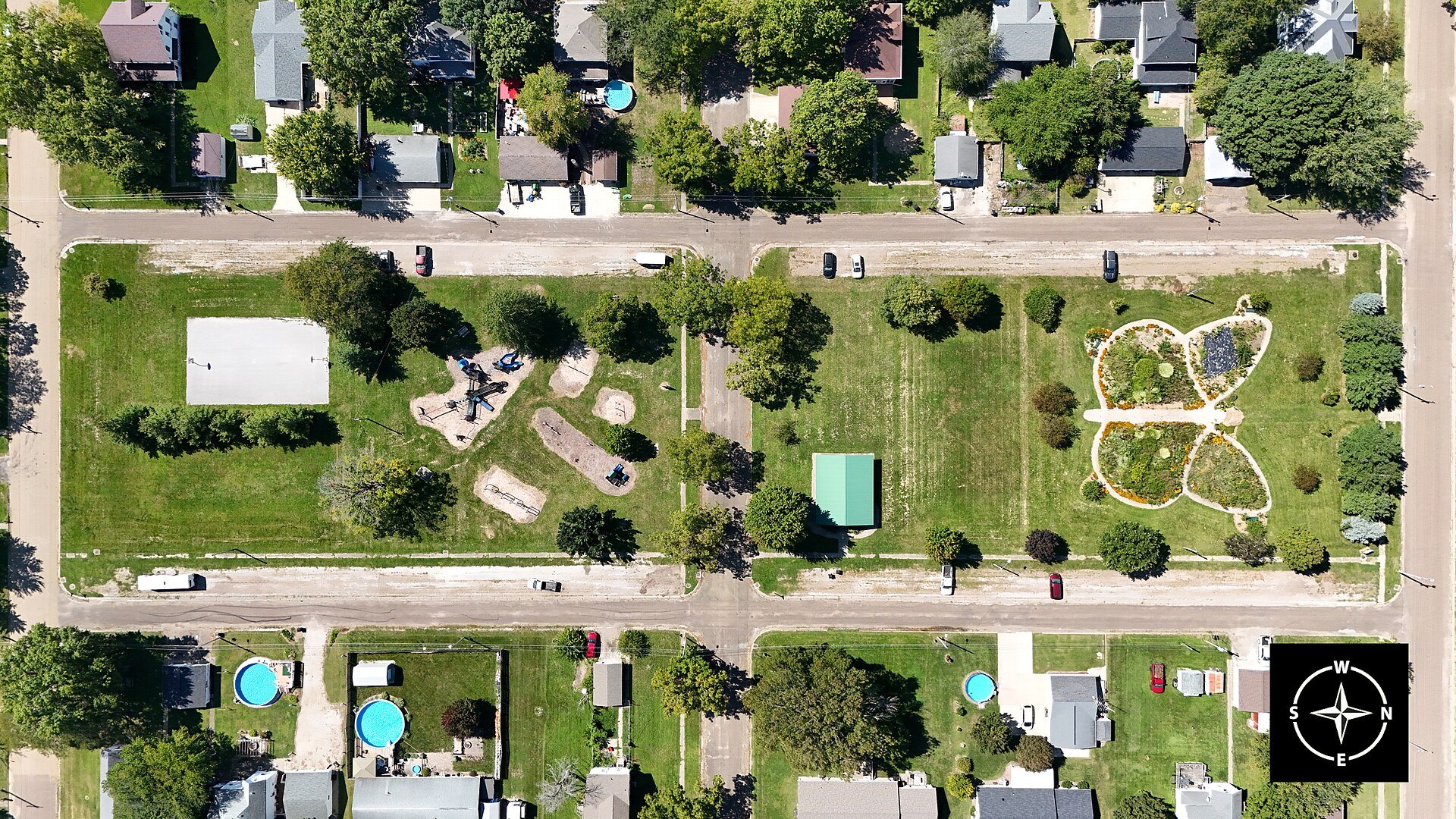
Photo: City park in Middletown, Iowa. PopePompus via Wikimedia Commons (CC BY-SA 4.0).
Families in southeast Iowa are waiting on laboratory results that will show whether the U.S. Army’s controlled detonation of roughly five tons of unstable lead azide left lead behind in their yards, schools and drinking water. The blast at the Iowa Army Ammunition Plant near Middletown on Wednesday destroyed the nation’s entire stockpile of the explosive, and federal officials say real-time air monitors have not picked up any airborne lead since.
The Environmental Protection Agency said Thursday that crews had gathered more than 1,000 air, water, soil and dust samples after the detonation, on top of 1,591 baseline samples taken beforehand. The samples went to the EPA’s regional lab in Kansas City, Kansas, and to mobile and private labs. The agency said the first results could arrive as early as Friday, though it has not said when they will be posted publicly.
USA State Wire reported Monday on the court ruling that cleared the way for the blast. This story covers what happened on detonation day and what residents should watch for now.
How the detonation went
The Army set off the charge at 10 a.m. Eastern time Wednesday. Crews had built earthen barriers and soaked the two bunkers holding the material with foam and water to absorb much of the blast, according to Yahoo News. Maj. Gen. Eric Shirley told reporters about two hours later that every barrel had been destroyed, with no secondary explosions and no damage to buildings on or around the installation, NPR reported.
Some neighbors said windows rattled. Others said they barely noticed. About 21 people chose to leave their homes beforehand, Bureau of Alcohol, Tobacco, Firearms and Explosives Director Rob Cekada said, and the Federal Emergency Management Agency had told people within 20 miles southwest of the plant to stay inside with windows closed. FEMA lifted that guidance with an all-clear at about 5:30 p.m., roughly nine hours after the blast, CBS News Chicago reported.
On Thursday, EPA teams sampled schools, playgrounds, day cares and churches and ran a second round of drinking water tests. Besides lead, the agency said it is checking for volatile organic compounds and fine particulate matter.
Why the Army chose to blow it up
Lead azide is a primary explosive used to ignite munitions, and the military has relied on it since World War I. The stockpile was moved to a bunker at the Middletown plant about 17 years ago, NPR reported. At some point, crystals formed inside the storage containers, leaving the material highly sensitive to movement and temperature swings. Authorities concluded in March that it was too unstable to move, and officials later ruled out chemical treatment because opening the containers risked setting it off.
The Army argued that a planned detonation in good weather was far safer than waiting for an accidental one as temperatures dropped. The EPA issued an emergency permit on the same reasoning. The blast was first set for Nov. 20 and was pushed back several times while two Iowa environmental groups sued to stop it. A federal appeals court cleared it on Monday.
By the numbers
- About 5 tons of lead azide destroyed, the entire U.S. stockpile
- 1,591 environmental samples collected before the blast
- More than 1,000 samples collected after it
- 4 sensors measuring airborne lead in real time, per CBS News Chicago
- 100 Iowa National Guard soldiers assigned to outreach for about 150 households
- 3 to 4 weeks until one independent group expects its own test results
Officials praise the result; scientists want proof
State leaders in Iowa and Missouri welcomed the early readings. Iowa Gov. Kim Reynolds praised the Army and federal agencies and called the outcome “a best-case scenario” for Middletown and nearby towns, while adding that the state would keep monitoring air, soil and water. Missouri Gov. Mike Kehoe, whose state’s northeast border sits about 40 miles from the plant, said no detectable lead was heading toward Missouri and that water and land in his state were safe.
EPA Administrator Lee Zeldin said the agency would stay on the ground as long as needed. Even with the clean readings, he advised parents to wipe down outdoor surfaces that children touch, such as play sets, railings and window sills, with a wet cloth.
Independent scientists are not ready to sign off. Toxicologist Devra Davis, a former member of the U.S. Chemical Safety and Hazard Investigation Board, told CBS News Chicago that “zero isn’t a real number,” meaning a reading of zero reflects the limits of the equipment, not proof that no lead is present. She has filed a public records request seeking details on the testing, the decision to detonate and the suppression foam. CBS also cited reporting by Inside Climate News that a University of Massachusetts Boston professor found seven readings above zero in the EPA’s underlying data that appeared as 0.0 on the public dashboard.
Andrew Whelton, a Purdue University engineer who studies environmental disasters, told NPR that poor public messaging had caused stress for residents and businesses and that he was worried about long-term follow-through on testing and cleanup. Some farmers share that worry. A livestock farmer in Donnellson told AP his cows are pregnant and he is hoping for healthy calves.
The Associated Press also flagged false maps circulating online that claimed to show a fallout path from the blast.
What it means for Iowa and Missouri
The people with the most at stake live in Des Moines County and the surrounding corner of southeast Iowa, along with farm communities in northeast Missouri. The Centers for Disease Control and Prevention says there is no safe level of lead exposure, and young children and pregnant people face the greatest risk. Lead does not break down, so any that settled on soil or surfaces could linger.
For now, the official guidance is that residents can return to normal routines. Families with small children can still take the basic lead-safety steps health agencies recommend: wet-wipe outdoor play equipment and sills, take shoes off at the door, and talk with a pediatrician about a blood lead test if there is any concern. Residents can follow EPA air data at epa.gov/IowaData or call the agency’s hotline at 833-649-9624.
For displaced households, there is also a deadline: covered short-term hotel stays for people who left their homes end Friday, according to CBS News Chicago.
What happens next
- Lab results: The EPA’s first results on soil, dust, water and air samples are expected starting Friday, with more to follow.
- Independent testing: The University of Iowa’s Center for Health Effects of Environmental Contamination has been sampling before and after the blast, and the nonprofit Blue Shirt Justice League plans a town hall when its results come back in three to four weeks.
- Records requests: Davis’s Environmental Health Trust is seeking federal documents on why a contractor’s alternative disposal plan was dropped in March.
- Ongoing monitoring: Iowa and Missouri say their own agencies will keep checking air, soil and water near the plant.
Sources
- AP: Test results from samples taken after Iowa lead detonation are expected soon, EPA says
- NPR: Army detonates nearly five tons of lead-based explosives in Iowa
- CBS News Chicago: Scientists Question EPA ‘Zero’ Lead Readings After Iowa Army Chemical Blast
- Yahoo News: Iowa lead detonation latest: EPA finds no airborne lead so far