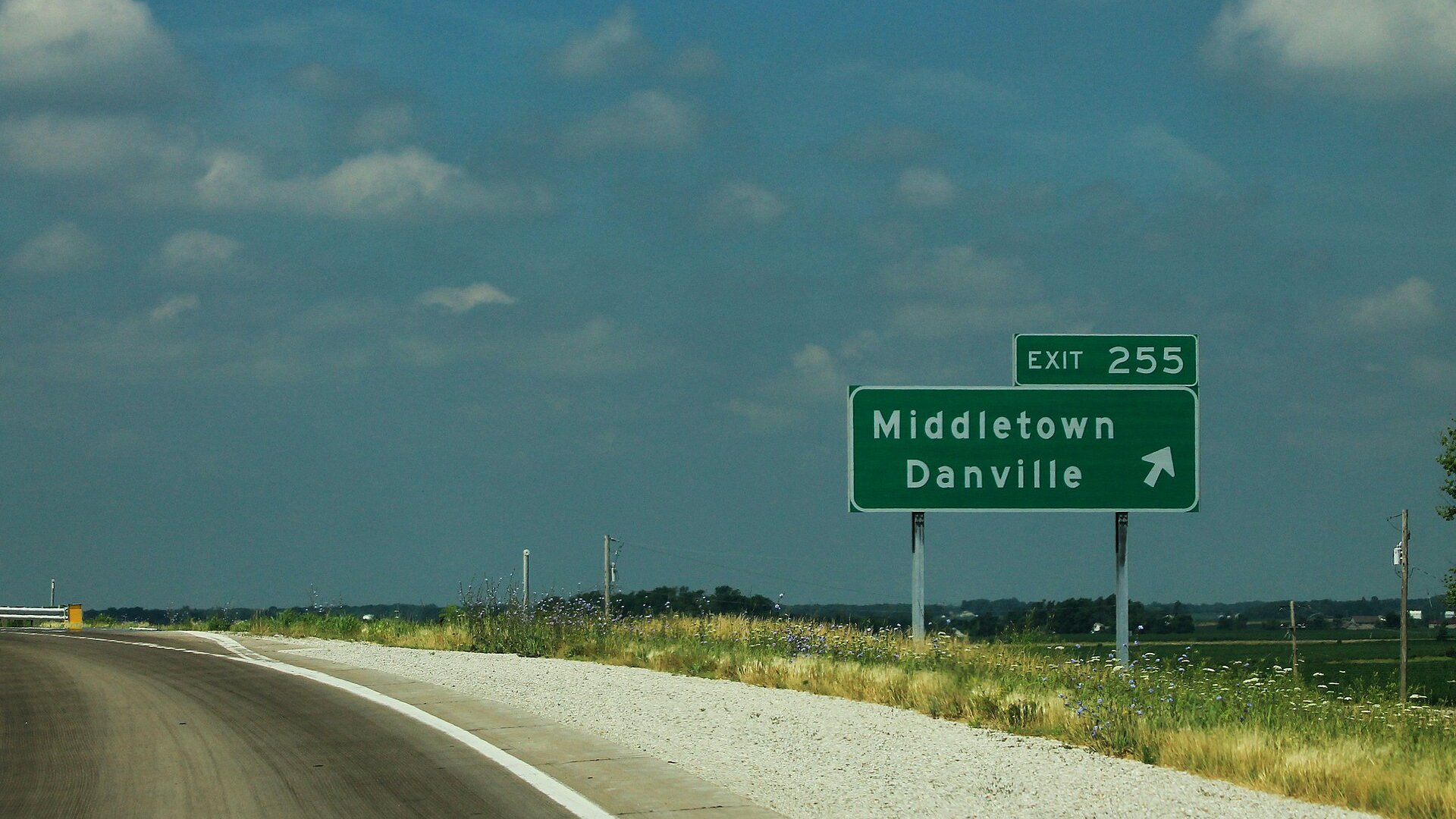
Photo: Highway exit sign for Middletown, Iowa, on U.S. Route 34. formulanone via Wikimedia Commons (CC BY-SA 2.0).
The U.S. Army plans to detonate 68 barrels of degraded lead azide at the Iowa Army Ammunition Plant near Middletown on Wednesday morning, after a federal appeals court on Monday rejected a bid by environmental groups to keep the permit for the blast on hold. The operation has drawn concern in Iowa and in neighboring Missouri and Illinois over lead dust that officials say will spread downwind.
In a statement late Monday, the Army said it was moving ahead with a controlled removal of the material in coordination with state, local and federal agencies, the Associated Press reported. Lead azide is a highly sensitive explosive used in munitions production. Iowa Public Radio reported that nearly 5 tons of it will be destroyed.
What the court decided
A three-judge panel of the 8th U.S. Circuit Court of Appeals found that an emergency permit issued by the U.S. Environmental Protection Agency included adequate safeguards to limit the spread of dust, according to the AP. The judges cited barriers placed around the storage area, restrictions on the weather conditions under which the blast may take place, advance public notice, updated air modeling, and environmental monitoring and sampling.
The panel also said the record showed the Army had considered a full range of alternatives, including neutralizing the lead azide with other chemicals and thermal treatment. The same court had temporarily halted the permit the previous Thursday at the request of the Iowa Environmental Council, the Sierra Club and Earthjustice.
After that stay, government lawyers argued in a filing late Saturday that the Army did not need a permit at all, because federal hazardous waste rules make an exception when a munitions emergency response specialist finds an immediate threat to health, safety or the environment. Environmental groups called that a way around the court process.
Why the Army says it cannot wait
Plant staff discovered several dozen barrels of degraded lead azide in March. Crystals had formed in the material, creating what the Army described as an unstable and dangerous situation. In a declaration filed with the court, Army Col. Aaron Teller, a munitions emergency response specialist, said lower liquid levels in the barrels make the contents more likely to freeze, which makes crystals around the lids more sensitive. Even slight friction could set off a chain reaction, he wrote, according to the AP.
Officials have said the danger rises as overnight temperatures drop below 30 degrees. EPA documents show the Army weighed chemical neutralization but concluded that handling the drums would raise the chance of an accidental, deadly explosion.
Background and timeline
The Iowa Army Ammunition Plant sits in southeast Iowa near the Mississippi River, about 160 miles southeast of Des Moines. Iowa Public Radio notes the plant is an active Superfund site with a history of environmental and worker safety problems. Middletown has close to 400 residents, but thousands more live in surrounding areas that could be affected.
- March 2026: Plant staff find dozens of barrels of degraded, crystallized lead azide.
- October: The Army describes its plans at a public meeting in Middletown.
- Early November: The EPA approves an emergency permit for the detonation.
- Mid-November: A public advisory and Army maps alert communities as far as 100 miles away to possible lead fallout.
- Nov. 19: The 8th Circuit temporarily puts the permit on hold.
- Nov. 20: Gov. Kim Reynolds activates the state emergency management office. The original detonation date passes.
- Nov. 21-22: The Army files its emergency argument, then announces a Wednesday target date.
- Nov. 23: The appeals court lifts the obstacle, and the Army says it will proceed.
- Nov. 25 (planned): Detonation, weather permitting.
Reactions
Acting Army Secretary Adam Telle wrote on social media that the decision had broad agreement among expert agencies and that both Iowa’s current and incoming governors had said the call belonged to the experts.
Earthjustice managing attorney Rachel Rintelmann said the groups respect the court’s ruling, but argued in a statement that the Army created the emergency through neglect and owes Iowans more information and stronger health protections. Her group stresses that its legal challenge targets the EPA permit, not the Army’s emergency authority.
President Donald Trump said on social media Monday that, in addition to the court’s go-ahead, he wanted Iowa Gov.-elect Rob Sand to approve the detonation. Sand, a Democrat who takes office in January, has said the decision belongs to the administration and the specialists it brought in months ago.
Middletown Mayor Rodney Johnson said the blast needs to happen so residents can move on with their lives. Missouri Gov. Mike Kehoe said his state is adding air, water, public health and agriculture monitoring. “The states of Iowa, Missouri and Illinois do not have a say,” Kehoe said, describing it as a federal operation.
What it means for Iowa, Missouri and Illinois
The blast will send up a plume containing lead particles that will settle on the ground, according to an official advisory. Officials have told people in the region to stay indoors during the detonation, keep doors and windows shut, bring pets and livestock inside, and rinse cars, windowsills and outdoor surfaces afterward. Vibrations could crack old windows, and some Middletown residents have been advised to leave the area.
The Iowa Department of Health and Human Services lists two main concerns: breathing lead particles right after the blast, and longer-term contact with dust that settles on soil, playgrounds and vehicles. University of Iowa professor Patrick O’Shaughnessy told Iowa Public Radio that the plume should not travel the way wildfire smoke does. “This is going to be much, much more constrained,” he said. He advised people in the plume path to turn off heaters so outside air is not drawn indoors.
Wind direction on Wednesday will decide who is affected. Experts told the station that northeastern Missouri could see some fallout depending on the wind, but St. Louis is unlikely to be affected. Washington University professor Jeffrey Catalano said the long-term risk to farmland appears low, and recommended keeping livestock indoors on feed rather than pasture for a couple of days. Iowa Public Radio also noted that no updated Army fallout map had been published since Nov. 17.
What happens next
The Army has said Wednesday offers the best weather window, but the blast depends on conditions meeting the permit’s limits, so the date could move again. Iowa has set up a dedicated website for the operation, and the Iowa Poison Control Center has published guidance for residents. The permit also requires environmental monitoring and sampling after the blast, which should show where the lead settles.
Sources
- AP: Court clears way for Army to detonate degraded bomb-making material in Iowa
- AP: Court told of US Army’s plans to detonate bomb-making chemicals in Iowa
- Iowa Public Radio: What Midwest residents need to know about the lead azide detonations