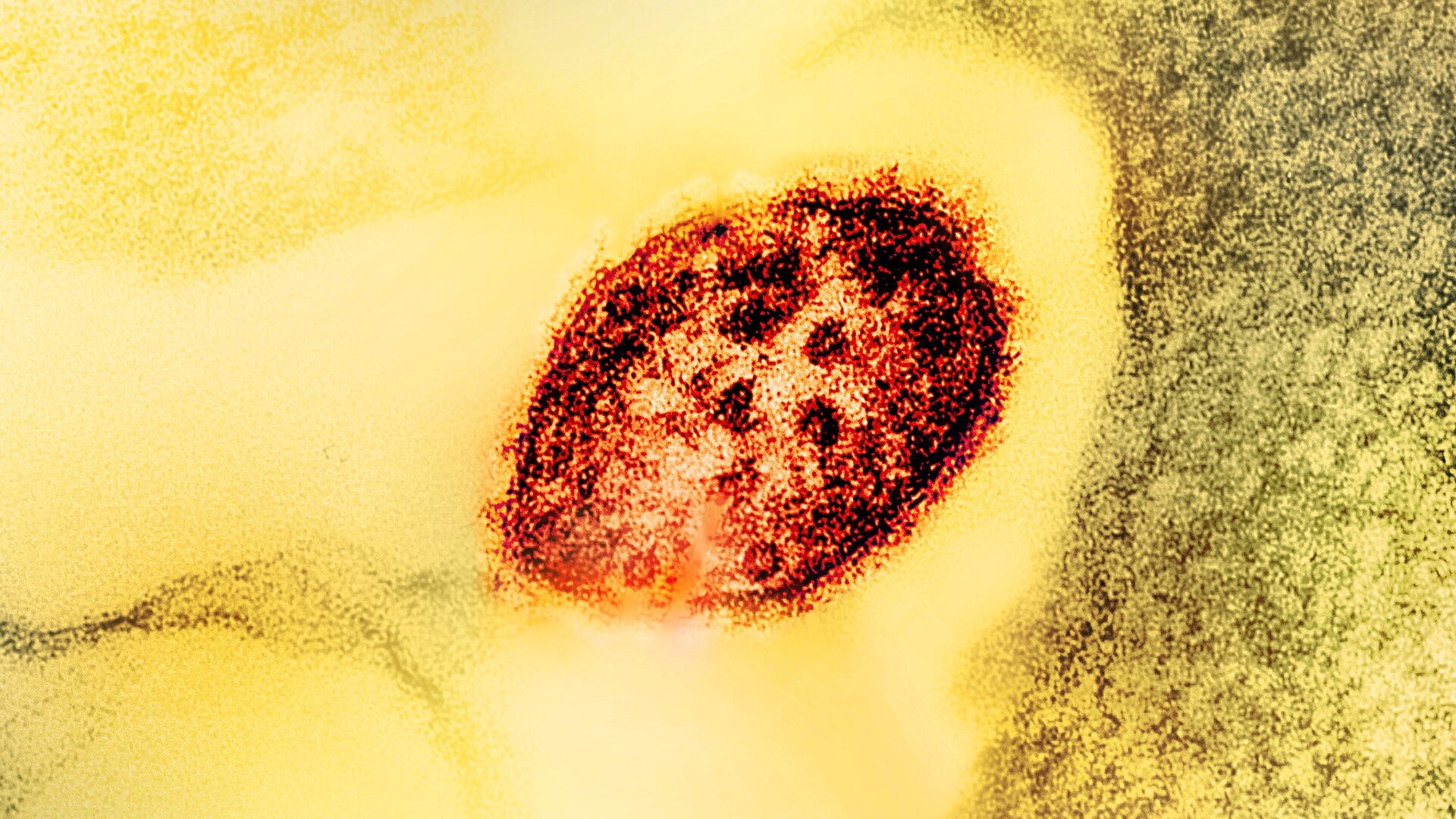
Photo: A measles virus particle seen through an electron microscope. NIAID via Wikimedia Commons (CC BY 2.0).
The Centers for Disease Control and Prevention now counts nine measles-related deaths in the United States this year, up from six less than two weeks earlier, as confirmed cases passed 6,000. The federal update, posted Wednesday, Nov. 25, arrived eight days after the Pan American Health Organization formally ended the country’s measles elimination status.
As of Nov. 24, the CDC had confirmed 6,039 cases in 47 jurisdictions, including 18 among international visitors, Reuters reported. That is the highest annual total since 1991. The agency has tracked 43 outbreaks in 2026. About 11% of patients, 671 people, have been hospitalized, and the share rises to 17% among children younger than 5.
States report an even higher toll. Reuters tallied at least 14 deaths announced by state health departments: nine in Pennsylvania, three in Wisconsin, and one each in Virginia and New York. The CDC said its own figure could change as it reviews more information.
Why the federal and state counts differ
The gap is a matter of method. Earlier this year the CDC stopped using state reports to count measles deaths and began relying on mortality data from the National Center for Health Statistics. A Department of Health and Human Services spokesperson told Reuters the latest increase followed NCHS receiving more state reports and verifying that measles was the underlying cause of death.
States typically use a broader standard. Pennsylvania records a measles-associated death when someone with a confirmed case dies within 30 days of the first symptoms, unless an unrelated event caused the death, Al Jazeera reported. Infectious disease specialists have warned that the CDC’s narrower approach breaks with long-standing tracking practice.
The dispute has played out in public. In August the CDC briefly listed Pennsylvania’s first two deaths, then removed them after Health Secretary Robert F. Kennedy Jr. questioned whether measles caused or contributed to them, according to Al Jazeera. Pennsylvania Gov. Josh Shapiro has pushed back on the federal classification. The CDC and the Council of State and Territorial Epidemiologists are now developing a shared definition.
How the year unfolded
- Aug. 25: Pennsylvania reports the deaths of two unvaccinated people, the state’s first measles deaths in more than three decades. The national case count stood at about 2,777, Axios reported.
- Early November: New York, Pennsylvania and Wisconsin each announce a measles death.
- Nov. 7: The CDC reports 5,182 cases, the most since 1991, and four deaths.
- Nov. 13: The CDC’s count reaches six deaths.
- Nov. 17: PAHO withdraws the U.S. elimination designation.
- Nov. 25: The CDC raises its count to nine deaths and 6,039 cases.
For comparison, the country recorded 2,289 cases and three deaths in all of 2025, and only 285 cases in 2024.
Elimination status lost after 26 years
The U.S. declared measles eliminated in 2000, meaning the virus no longer circulated continuously inside its borders. On Nov. 17, PAHO Director Jarbas Barbosa said endemic transmission had been reestablished in the United States, Mexico and Bolivia, accepting the advice of a regional verification commission that met Nov. 10-13, Contagion Live reported.
Under PAHO’s rules, a country loses the designation when the same chain of transmission persists for 12 months or longer. Before the decision, Reuters reported that an outbreak spanning Arizona and Utah, which began in June 2025 and continued into this year, likely met that threshold.
CDC Director Erica Schwartz responded that “the measles elimination designation is not what protects Americans,” adding that vaccination does. The CDC says it has directed $100 million to state and local health departments and intends to win the status back. To do that, the U.S. must submit a corrective action plan and go at least 12 months without endemic spread.
Who is getting sick
Almost every patient this year was unvaccinated or had an unknown vaccination history. CDC figures compiled by Contagion Live as of Nov. 12 showed 96% of cases fell into that group, while 2% had received one dose of the MMR vaccine and 2% had two doses. Children and teens ages 5 to 19 made up 40% of cases, adults 20 and older made up 41%, and children under 5 accounted for 18%. Roughly 96% of cases were linked to outbreaks.
Vaccination coverage among kindergartners has fallen from 95.2% in the 2019-2020 school year to 92.4% in 2025-2026. Public health officials consider about 95% the level needed to stop sustained spread. The shortfall leaves an estimated 280,000 kindergartners without protection.
What it means for affected states
Pennsylvania has absorbed the heaviest losses. Its outbreak is centered in Lancaster County, and the state had logged 1,487 cases by early November. The deaths in Wisconsin, Virginia and New York show the toll is spread across several regions, and outbreak-linked cases have surfaced in dozens of jurisdictions.
For state and local health departments, every case sets off contact tracing, exposure notices and, often, quarantine guidance for schools and child care centers. Hospital stays for young children add pressure on pediatric units at the same time flu and other respiratory viruses peak. The $100 million in federal support is meant to help absorb that work, but outbreak response also draws on state budgets.
For families, health departments continue to give the same advice: confirm that children and adults have had both MMR doses, and call ahead before visiting a clinic or emergency room if measles is suspected so staff can keep others from being exposed. That guidance carries extra weight during a holiday week when millions of people are traveling and gathering indoors.
What happens next
- The CDC updates its national case and death counts weekly, and says the death total may still change as NCHS reviews more state reports.
- The CDC and the Council of State and Territorial Epidemiologists are working toward a standard definition of a measles death, which could narrow the gap between federal and state numbers.
- The U.S. must give PAHO a corrective action plan and show at least 12 months without endemic transmission before it can regain elimination status.
Sources
- Reuters (via WTAQ): US CDC reports nine measles-related deaths in 2026
- Contagion Live: It’s Official: US Loses Measles Elimination Status
- Al Jazeera: CDC reports more than 5,000 measles cases, highest number in 35 years
- Contagion Live: Measles Update: November 13, 2026
- Axios: U.S. measles crisis deepens with first 2026 deaths