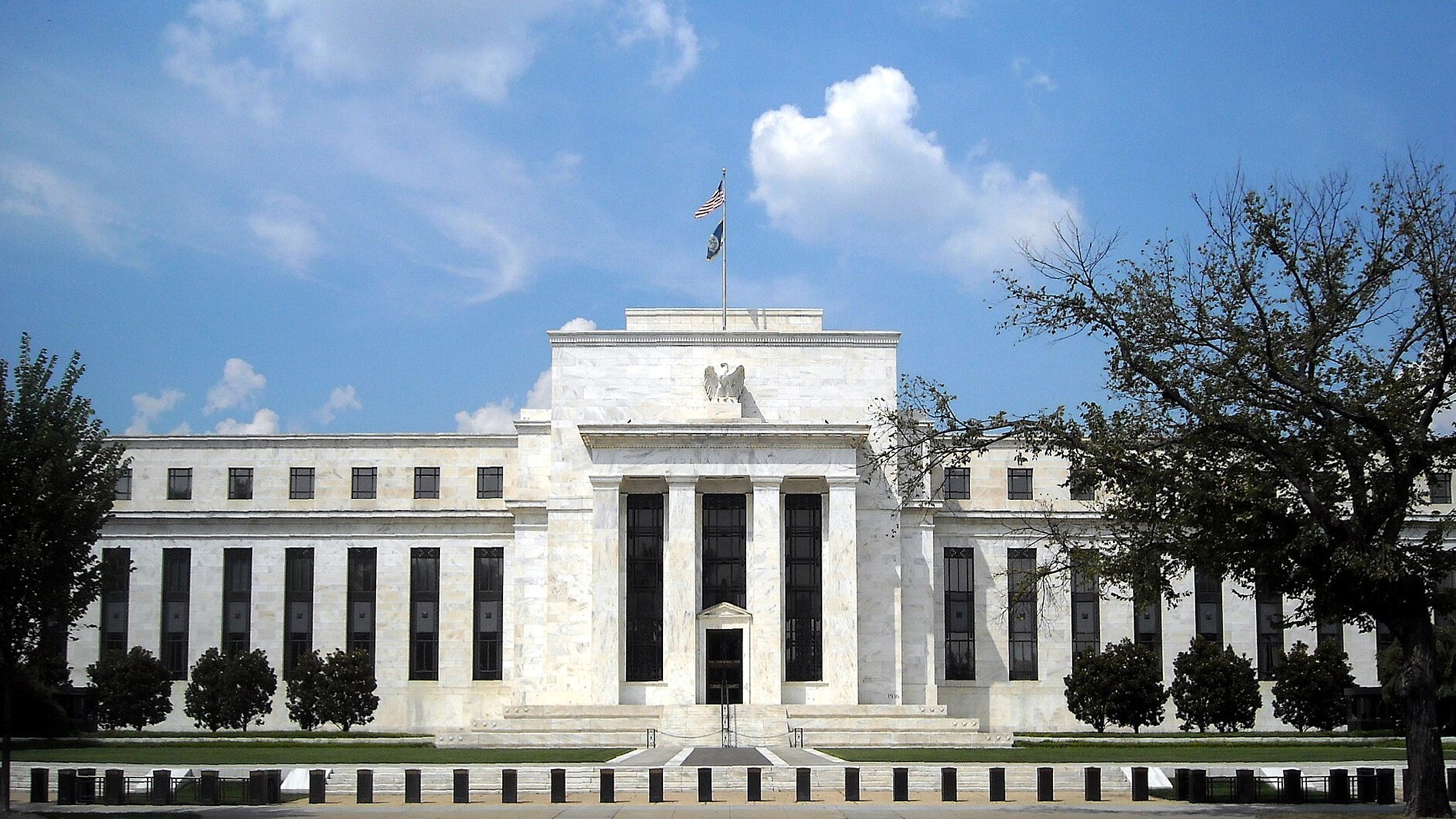
Photo: Marriner S. Eccles Federal Reserve Board Building in Washington. AgnosticPreachersKid via Wikimedia Commons (CC BY-SA 3.0).
The U.S. economy grew at a 4.3% annual rate from July through September, far faster than first estimated, while a key inflation gauge showed prices still rising 3.8% from a year earlier in October, the Bureau of Economic Analysis reported Wednesday, Nov. 25. The same morning, the Labor Department said first-time claims for unemployment benefits fell to 189,000, tying the lowest level of 2026.
Taken together, the three reports describe an economy that is expanding quickly, a job market where few people are being laid off, and an inflation problem that has not gone away. That combination matters for households in every state. It is the backdrop for the Federal Reserve’s last policy meeting of the year, which ends with a rate decision on Dec. 9.
Growth revised up nearly a full point
BEA’s second estimate put third-quarter real GDP growth at 4.3%, up from the 3.4% advance figure the agency released on Oct. 29. Growth in the second quarter was 2.2%. Economists surveyed by Reuters had expected only a small revision, to about 3.5%.
The agency said the upgrade mainly reflected higher estimates for business investment and consumer spending. On the investment side, BEA raised its numbers for intellectual property, chiefly software, after folding in new producer price data. Consumer spending on goods was also revised up, with pharmaceuticals, recreational goods and vehicles, and gasoline and other energy goods all stronger than first thought. Spending on services moved the other way, led by a downward revision to health care.
For the quarter as a whole, growth came from investment, consumer spending and government spending. Weaker exports partly offset those gains, and imports, which are subtracted when GDP is calculated, rose.
A second yardstick of output, real gross domestic income, grew 4.4%. The average of GDP and GDI, which some economists use to smooth out measurement noise, was also 4.4%. Corporate profits from current production rose $206.0 billion in the quarter, a smaller gain than the $384.0 billion jump in the second quarter.
Inflation measured inside the GDP report looked calmer. The PCE price index rose at a 2.1% annual rate during the quarter, and the core index, which strips out food and energy, rose 2.5%. Both were unchanged from the advance estimate.
October inflation is still running hot
The monthly figures were less comforting. In its October personal income and outlays report, BEA said the PCE price index rose 0.3% from September and 3.8% from October 2025. Core PCE prices, the measure Fed officials watch most closely for the underlying trend, also rose 0.3% for the month and 3.3% over 12 months. Both annual rates sit well above the central bank’s 2% goal, although the monthly headline gain did cool from 0.5% in September.
Personal income jumped $201.8 billion, or 0.7%, after a 0.3% increase in September. BEA credited higher pay, larger government social benefits and dividend income. Much of the boost to social benefits came from one-time premium rebate payments out of the Medicare Improvement Fund, so part of October’s income gain will not repeat.
Consumer spending rose $63.8 billion, or 0.3%. Households spent $11.8 billion more on goods and $52.1 billion more on services. After adjusting for inflation, however, spending was flat, with real PCE slipping $5.8 billion. Put simply, Americans paid more in October without buying more. Because income outpaced spending, the personal saving rate came in at 4.1% of disposable income, or about $1.00 trillion at an annual rate.
Layoffs remain rare
The Labor Department released its weekly claims report a day early because of Thanksgiving. Initial claims for state unemployment benefits fell 13,000 to a seasonally adjusted 189,000 in the week ended Nov. 21, from a revised 202,000 the week before. Economists polled by Reuters had forecast 200,000. The figure matched the week ended July 18 as the lowest of the year.
Continuing claims, which count people still receiving benefits after their first week, dropped 95,000 to 1.697 million in the week ended Nov. 14. That week overlapped with the government’s household survey for November’s unemployment rate. The jobless rate was 4.1% in October, and Reuters reported that a Chicago Fed real-time model points to roughly 4.2% for November.
Reuters described the job market as “low-hire, low-fire,” meaning employers are holding on to workers but not adding many. Consumers appear to be noticing the stability. The share of people telling the Conference Board that jobs are plentiful rose in November to its highest level since May 2025, Reuters reported.
The key numbers
- Third-quarter real GDP growth: 4.3% (second estimate), up from 3.4%
- Real gross domestic income: 4.4%
- Third-quarter corporate profits: up $206.0 billion
- October PCE prices: up 0.3% for the month, 3.8% from a year earlier
- October core PCE prices: up 0.3% for the month, 3.3% from a year earlier
- October personal income: up 0.7%; consumer spending up 0.3%; inflation-adjusted spending flat
- Personal saving rate: 4.1%
- Initial jobless claims: 189,000 (week ended Nov. 21)
- Continuing claims: 1.697 million (week ended Nov. 14)
What it means for the Fed
Growth above 4%, inflation near 4% and layoffs near the year’s low are the conditions that push a central bank toward tighter policy. Reuters reported that the steady labor market likely clears the way for another rate increase beyond the one widely expected at the December meeting. Wednesday’s PCE figures were the last major inflation reading policymakers will see before they vote.
There is a counterweight. Real consumer spending stalled in October, and a slice of the month’s income growth came from one-off payments. Officials will have to judge whether households are starting to pull back under the weight of higher prices before deciding how far and how fast to move.
What it means for the states
National totals are built from activity in all 50 states, and the effects flow back to them. Weekly jobless claims are filed through each state’s own unemployment insurance program, so a national count near the year’s low means layoffs are staying uncommon across regions rather than in a single part of the country.
If the Fed raises rates again, residents everywhere would feel it through mortgage, auto loan and credit card costs. State and local governments would also pay more to borrow when they sell bonds for roads, schools and water systems. Persistent inflation cuts both ways for state budgets: it raises what governments pay for contracts, supplies and payroll, while lifting sales tax collections on more expensive goods.
The quarter’s state-by-state picture is coming soon. BEA will publish third-quarter GDP and personal income for every state on Dec. 23, alongside its third national estimate. That release will show which states powered the summer surge and which fell behind.
What happens next
- Early December: The Labor Department’s November employment report, the final jobs reading before the Fed meets.
- Dec. 8-9: Federal Reserve policy meeting, with the rate decision announced Dec. 9.
- Dec. 23: BEA’s third estimate of third-quarter GDP, along with state GDP and state personal income, plus the November personal income and outlays report.
Sources
- Bureau of Economic Analysis: GDP (Second Estimate) and Corporate Profits, 3rd Quarter 2026
- Bureau of Economic Analysis: Personal Income and Outlays, October 2026
- Bureau of Economic Analysis: GDP (Advance Estimate), 3rd Quarter 2026
- Reuters (via WHBL): US weekly jobless claims fall more than expected