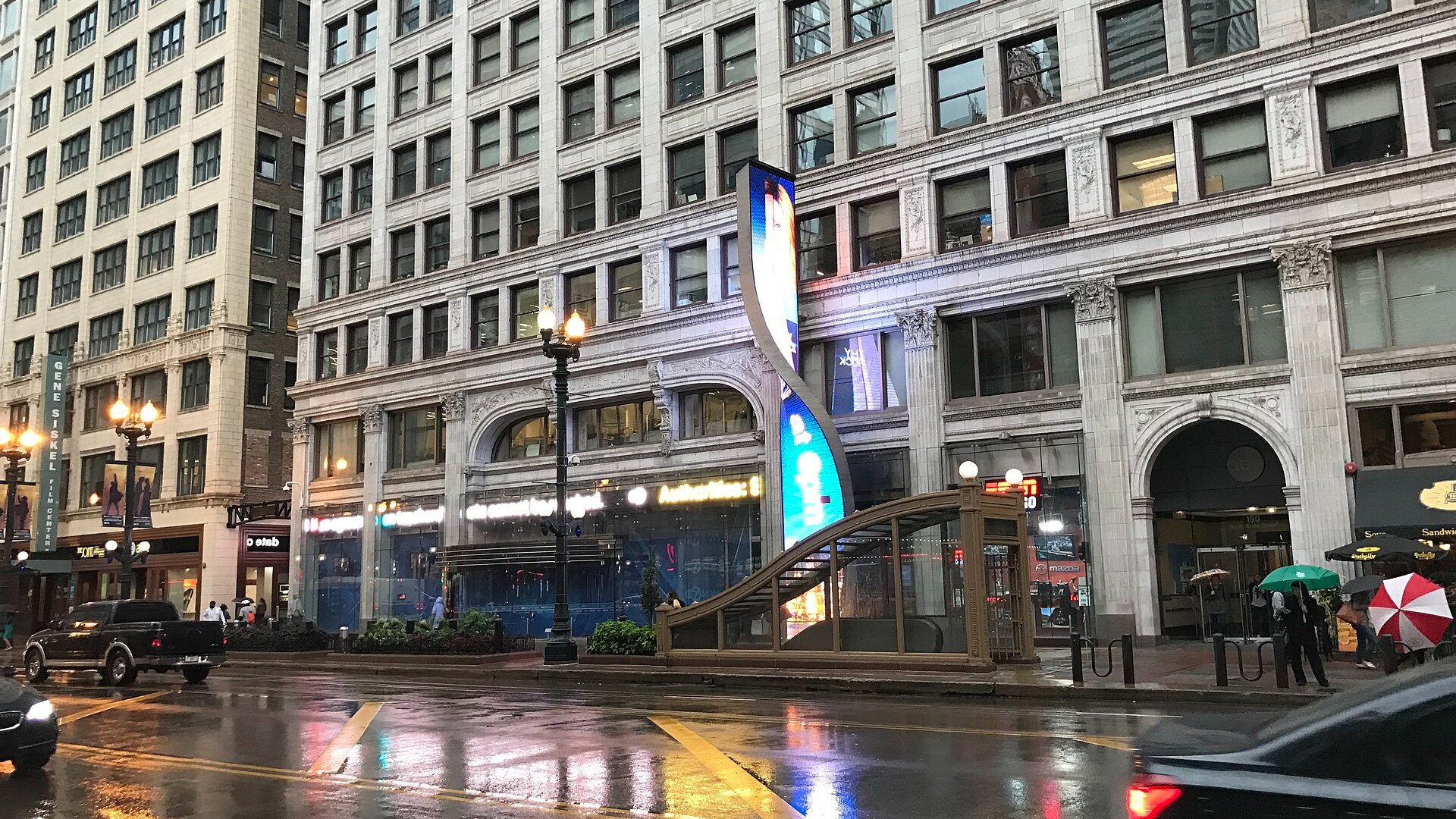
Photo: WLS-TV studios on State Street, Chicago. Mrschimpf via Wikimedia Commons (CC BY-SA 4.0).
A federal judge in Washington, D.C., on Wednesday stopped the Federal Communications Commission from pressing ahead with an unusual early review of the broadcast licenses held by eight ABC-owned television stations, ruling that the network is likely to prove the review was government retaliation for news coverage, comedy and commentary that President Donald Trump disliked. The stations serve viewers in New York, California, Illinois, Pennsylvania, Texas and North Carolina.
U.S. District Judge Loren AliKhan granted ABC and its parent company, the Walt Disney Co., a temporary restraining order and a preliminary injunction on First Amendment grounds, the Associated Press reported. She also turned down the Justice Department’s request to throw out the lawsuit. “This is not a close case,” she wrote, according to Time.
The order freezes the renewal proceedings the FCC opened in April. It does not end the case, and it does not prevent the agency from reviewing ABC’s licenses when they come up on the normal schedule.
What the judge found
Much of the ruling rests on the public record. AliKhan cataloged statements and social media posts by Trump and by FCC Chairman Brendan Carr attacking ABC and Disney. NPR reported that she counted eleven separate calls by the president over the past two years for the commission to take away ABC’s licenses, the latest in July 2026. In one of the sharpest lines in the opinion, she wrote that “Chairman Carr has taken President Trump’s rhetoric as his marching orders.”
The judge also rejected the government’s argument that a court has no business stepping in before the FCC actually denies a renewal. Losing a license would be a far greater harm, she acknowledged, but being singled out for review years ahead of schedule is an injury in its own right, because the threat alone can push a broadcaster to change what it airs. She concluded that the threat of losing a license was serious enough to chill an ordinary broadcaster.
ABC did not get everything it wanted. AliKhan declined a broader request to bar the FCC from any formal or informal effort to pressure the network over its editorial choices. She said ABC had not identified what those future threats would be beyond the license proceedings themselves.
How the fight started
Broadcast licenses normally run for eight years, and the FCC renews them on a staggered calendar by region. Revoking one is rare. What made this case stand out was the FCC’s decision on April 28 to demand renewal applications from all eight ABC-owned stations at once, years before they were due. According to Time, none of the licenses was set to expire before 2028. Carr himself told the Financial Times in May that the commission had not used the tool in 50 or 60 years.
The timing drew scrutiny. The order came days after an April 23 monologue joke by late-night host Jimmy Kimmel prompted Trump to call for his firing. It also followed months of friction between Carr and ABC, including the chairman’s push to apply equal-time rules to the daytime talk show “The View” and an FCC inquiry into a February appearance on that show by James Talarico, then a Democratic U.S. Senate candidate in Texas. Talarico won his Senate race this month.
Key dates in the dispute:
- December 2024: ABC settles Trump’s defamation suit, agreeing to pay about $16 million, most of it toward his presidential library.
- September 2025: Disney briefly pulls Kimmel’s show off the air after Carr threatens regulatory action over a monologue.
- April 28, 2026: The FCC orders early renewal reviews for eight ABC-owned stations.
- August 2026: ABC and Disney sue the FCC and Carr.
- October 2026: Lawyers argue the injunction request in federal court.
- November 25, 2026: AliKhan blocks the early review.
Disney’s posture has shifted since the 2024 settlement. Josh D’Amaro, who became chief executive in March, told CNBC in August that the company would defend ABC’s journalistic independence, NPR reported. ABC’s lawyers told the court that pressure from the FCC had already shaped newsroom decisions, pointing to a Kimmel interview with Talarico that went to YouTube instead of broadcast television and to “The View” halting appearances by political candidates ahead of the fall elections.
The FCC’s side
Carr has said the license review grew out of a separate FCC investigation into whether Disney’s diversity, equity and inclusion programs amounted to unlawful discrimination, and that broadcasters owe a duty to serve the public interest. He told NPR in August that the lawsuit lacked merit and that the agency would follow the facts and the law.
Justice Department lawyers argued that blocking the review would keep regulators from using every tool available to check whether ABC was meeting its legal duties. At the October hearing, NPR reported, a government attorney described the early review as a way to get information the agency said Disney had not fully provided. Pressed by the judge, he acknowledged the FCC had other options, such as subpoenas or fines. AliKhan noted in her order that Disney had answered each FCC query in the diversity probe. Carr has called those answers deficient.
After the ruling, an FCC spokesperson called the decision “wrong on the facts and wrong on the law,” according to AP, and said the agency expects to win the case in full. The commission added that it would keep holding broadcasters to their public interest obligations.
Reactions
An ABC News spokesperson called the ruling an important win for the First Amendment. Anna Gomez, the only Democrat on the commission, said in a statement that the agency had used its licensing power to punish broadcasters for their speech and urged other stations not to give in to similar pressure. The Freedom of the Press Foundation said outlets that have faced pressure from Carr now had reason to fight back in court.
The ruling lands about six weeks after another federal judge, Timothy Kelly, issued a preliminary injunction in a lawsuit by CNN, MS NOW and Politico over the White House barring their reporters. The administration is appealing that decision, NPR reported.
What it means for New York, California, Illinois, Pennsylvania, Texas and North Carolina
ABC’s eight owned stations are WABC in New York, KABC in Los Angeles, WLS in Chicago, WPVI in Philadelphia, KTRK in Houston, KGO in San Francisco, WTVD in Raleigh-Durham and KFSN in Fresno. NPR noted that ABC and Disney serve six of the country’s 10 largest TV markets. Together these stations carry local newscasts, severe weather coverage and emergency alerts for tens of millions of people.
For viewers, nothing on the air changes right away. The practical effect is that these stations no longer face an open-ended license proceeding while the lawsuit moves forward. That matters for local newsrooms: a pending challenge to a station’s license can weigh on budgets, staffing and coverage decisions, and the judge’s central finding was that the review itself created pressure on editorial choices.
The case also matters to station groups in every state. Thousands of local stations operate under FCC licenses, and the commission is weighing other changes to the industry, including a December vote on local TV and radio ownership limits. A ruling that an early license review can be challenged in court before any final decision gives other broadcasters a clearer path to contest similar moves.
What happens next
The injunction stays in place while the lawsuit proceeds in U.S. District Court in Washington. The FCC has not said publicly whether it will ask the U.S. Court of Appeals for the D.C. Circuit to lift the order, though its statement made clear it intends to keep fighting. The separate FCC investigation into Disney’s diversity practices was not part of the injunction, and ABC’s licenses will still come up for renewal on the regular schedule starting in 2028.
Sources
- AP: Judge halts ABC license review, saying Trump administration likely violated free speech rights
- NPR: U.S. Judge rules FCC violated ABC’s free speech rights to please Trump
- Time: ‘Not a Close Case’: Judge Strikes Down Trump Administration’s Targeting of ABC