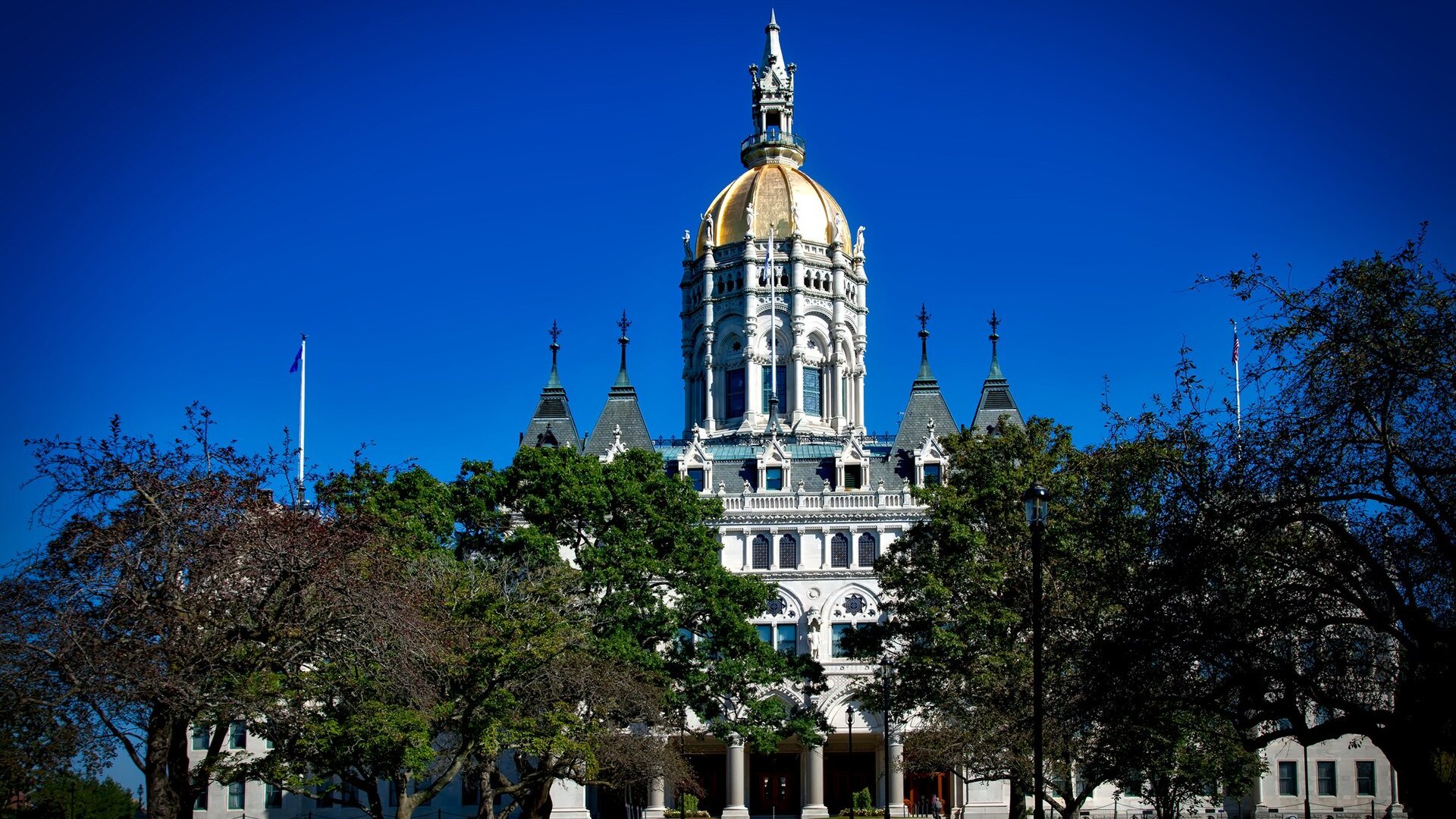
Photo: Connecticut State Capitol in Hartford. 12019 via Wikimedia Commons (CC0).
Connecticut is on track for a $612.4 million surplus this fiscal year, but the state’s budget will slip into deficit in fiscal 2028 as costs grow about six times faster than revenue, according to the legislature’s nonpartisan Office of Fiscal Analysis. The projection sets up a hard first year for the new Democratic supermajorities when the General Assembly returns in January to write a two-year budget.
The office’s annual Fiscal Accountability Report, released Nov. 20, projects General Fund deficits of $240.8 million in fiscal 2028, $177.7 million in fiscal 2029 and $84.6 million in fiscal 2030. Across all appropriated funds, including the Special Transportation Fund, the gap reaches $457.6 million in fiscal 2028.
Why the numbers turn
The core problem is a one-year mismatch. OFA expects General Fund spending to grow by $1.01 billion in fiscal 2028, driven mostly by fixed costs such as entitlement programs, while net revenue grows by just $158.5 million. Underlying tax growth is healthier, at $691.9 million, but the analysts subtract $533.4 million in policy changes and technical adjustments that wipe out most of the gain.
The largest of those is the loss of one-time money. The current budget was balanced in part with $347.7 million in surplus fiscal 2026 revenue carried forward, and that cushion will not exist for the next budget. Federal grant revenue is also projected to fall by $106.6 million in fiscal 2028, mainly because of updated estimates for Medicaid administration.
OFA said fixed costs are growing at an annualized 4.1%, compared with 2.6% for other spending. Education grants and wage increases for state employees and some nonprofit providers are the biggest drivers on the non-fixed side. The analysts calculated a structural gap of $319.7 million in fiscal 2028 that narrows to near balance in the two years after.
Key numbers from the report
- $612.4 million: projected General Fund surplus for fiscal 2027, $271 million above the budgeted $341.4 million
- -$240.8 million: projected General Fund deficit in fiscal 2028
- $1.01 billion: projected fiscal 2028 spending growth, against $158.5 million in net revenue growth
- $4.48 billion: Budget Reserve Fund balance, held at the 18% statutory cap
- More than $1.3 billion a year: projected volatility deposits through fiscal 2030, mostly used to pay down pension debt
- Fiscal 2030: when OFA expects the Special Transportation Fund to become insolvent without policy changes
A strong year, for now
The current year looks good because revenue has beaten expectations. OFA raised its sales tax estimate by $123.8 million, saying consumer spending has stayed resilient despite inflation. Corporation tax receipts were raised by $150 million, largely from a one-time windfall tied to the state decoupling from a federal tax change on research expenses. Higher short-term interest rates added $46 million in investment income.
A strong stock market, which the report linked partly to AI-related investment, also lifted estimated capital gains. Projections for the volatile estimated and final income tax payments and the pass-through entity tax rose by a combined $500 million. Under Connecticut law, that money does not flow into the regular budget. It goes to the reserve or to pay down long-term debt, mainly the State Employees Retirement System and the Teachers’ Retirement System.
Those offsets were partly eaten up by $193.8 million in agency deficiencies, including higher costs for state employee fringe benefits, workers’ compensation claims and Medicaid. Under current law, the entire fiscal 2027 General Fund surplus will go to the Early Childhood Education Endowment Fund.
Transportation fund heads for trouble
OFA described the outlook for the Special Transportation Fund, which pays for the Department of Transportation and debt on highway, bridge and rail projects, as negative. The fund is projected to end fiscal 2027 with a $256.3 million surplus, but only because of $223 million in budgeted transfers from prior years. After that, deficits grow from $131.9 million in fiscal 2028 to $308.9 million in fiscal 2030 as revenue stagnates. Without changes, OFA expects the fund to become insolvent in fiscal 2030.
Two smaller funds also face trouble. The Municipal Revenue Sharing Fund and the Cannabis Regulatory Fund depend on General Fund transfers that are authorized only through fiscal 2027.
The political fight: guardrails
The report lands in the middle of a debate over Connecticut’s “fiscal guardrails,” the spending cap and volatility cap adopted in 2017. The CT Mirror reported that the caps have produced surpluses averaging almost $1.9 billion a year, or 8% to 9% of the General Fund, since 2017, and have helped the state pay down pension debt. The Budget Reserve Fund is now at its 18% cap, and OFA’s stress test found it could carry the state through a recession on the scale of the early 2000s dot-com downturn, though not one as deep as the Great Recession.
Democrats, who will hold 116 of 151 House seats and 33 of 36 Senate seats, want to set aside less and use more money for education, social services, municipal aid and tax relief for low- and moderate-income households, according to the CT Mirror. Rep. Toni Walker, the New Haven Democrat who co-chairs the Appropriations Committee, summed up the coming year bluntly: “The Band-Aid’s off.”
Gov. Ned Lamont has signaled caution. He said this week that the state should not commit volatile revenue to permanent tax cuts or spending it cannot sustain if markets fall, the CT Mirror reported. His budget director, Office of Policy and Management Secretary Josh Wojcik, described the out-year deficits as relatively modest and said the state’s long-term finances remain strong. Lamont has also highlighted how pension paydowns funded by the guardrails are saving the state money.
Republican leaders, House Minority Leader Vincent Candelora and Senate Minority Leader Rob Sampson, said their past proposals for savings were rejected. They have called for scaling back state employee raises, eliminating unfilled positions, reducing Medicaid coverage for undocumented residents and finding efficiencies at public colleges, and they point to about $29 billion in unfunded pension obligations.
What it means for Connecticut
For residents, the gap puts several things on the table at once. Cities and towns received more than $280 million in new aid this year, which required exceeding the spending cap, and Lamont agreed to that only as a one-time waiver, the CT Mirror reported. Lawmakers will have to approve another exception or find the money elsewhere to keep it. Medicaid, the state’s largest expense, has run hundreds of millions of dollars over budget in recent years, and federal health care support is set to shrink steadily through 2034 after federal changes enacted in 2025. More than $4 billion in pandemic aid is gone, and some lawmakers want a state food benefit for tens of thousands of residents who lost federal SNAP benefits.
Drivers and transit riders have a stake too. An insolvent transportation fund would force tough choices on fuel and vehicle taxes, fees, borrowing or project spending.
What happens next
The General Assembly’s 2027 session opens in January, and as an odd-numbered year it will be a long session focused on a two-year budget for fiscal 2028 and 2029. Lamont is expected to present his budget proposal early in the session, and the Appropriations and Finance committees will then build their own versions. OFA and the governor’s budget office will update revenue estimates again in the spring, before lawmakers vote on a final plan.
Sources
- Connecticut Office of Fiscal Analysis: Fiscal Accountability Report FY 27 – FY 30
- CT Mirror: CT to feel the squeeze as spending set to grow beyond revenue
- CT Mirror: Lamont: CT’s savings habits pay big dividends in next budget
- CT News Junkie: Improvements in CT pension funding will save state hundreds of millions of dollars, officials say