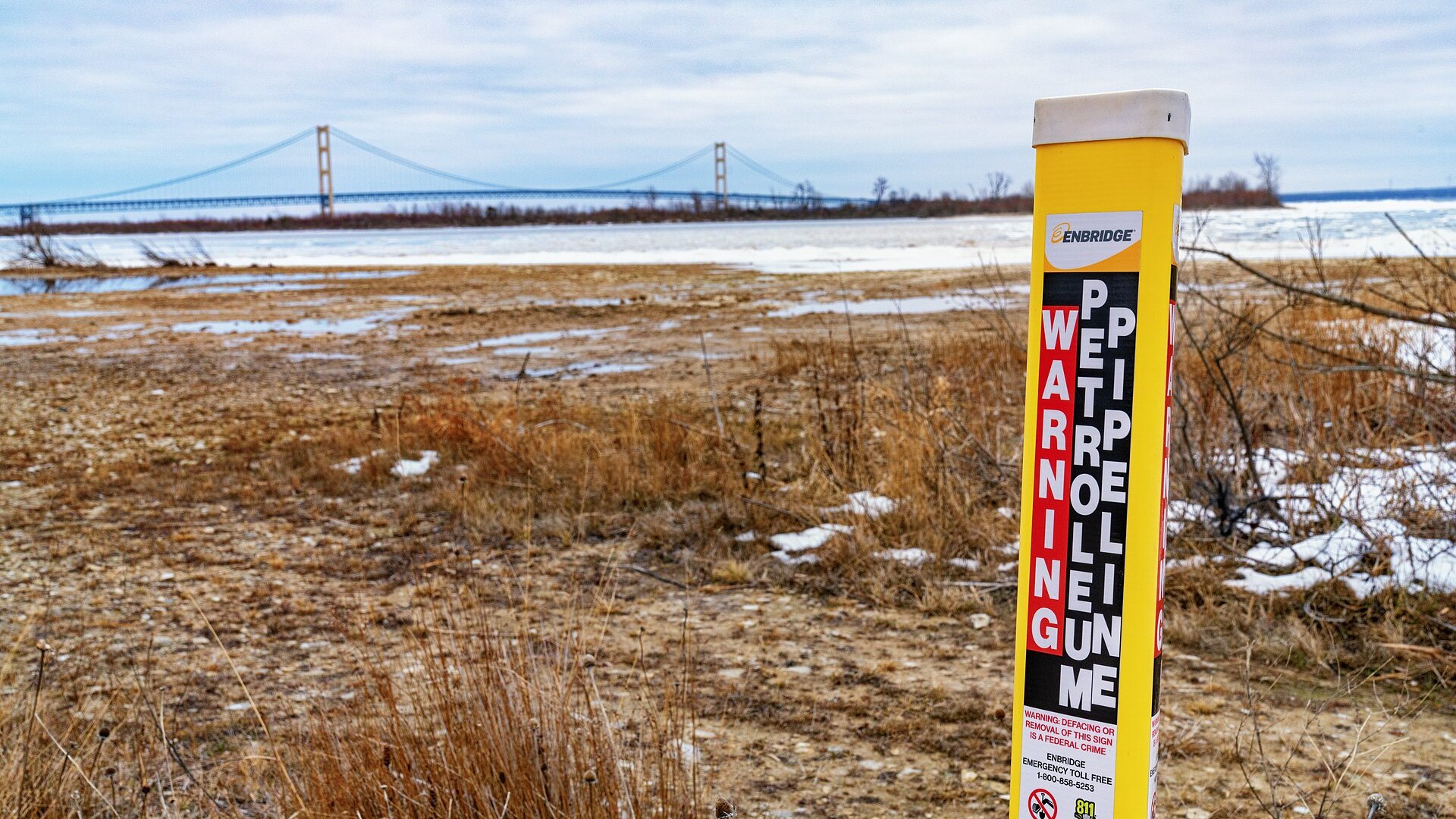
Photo: Enbridge pipeline warning sign at the Line 5 site on the Straits of Mackinac, with the Mackinac Bridge. Tony Webster via Wikimedia Commons (CC BY 2.0).
Michigan Gov. Gretchen Whitmer on Tuesday, Nov. 24, directed the state Department of Environment, Great Lakes, and Energy (EGLE) to stop all further action on the environmental permits for Enbridge’s proposed oil pipeline tunnel beneath the Straits of Mackinac until the project’s legal questions are settled. The order covers the resource permits EGLE issued in July and a wastewater discharge permit the agency had not yet decided.
The governor’s office said the move responds to a Michigan Supreme Court decision this summer that threw out the project’s state siting approval. For now, it means the Great Lakes Tunnel Project, first proposed in 2018 as a fix for the aging Line 5 pipeline, has no clear path to construction in Michigan, while the existing pipeline keeps running on the lakebed.
What Whitmer ordered
According to the governor’s press release, Whitmer told EGLE to suspend action on both the resource permits and the pending wastewater permit tied to the tunnel. The release frames the step as a pause, not a revocation. No end date was set. The suspension runs until the legal questions surrounding the project are resolved.
EGLE said in a statement, as reported by the Michigan Advance, that it was stepping back until there is greater clarity on the project’s legal footing.
Two sets of permits are affected:
- Resource permits. EGLE approved these on July 15, 2026. Pipeline opponents then filed two requests for a contested case hearing, arguing the permits threaten the environment as well as tribal lifeways and cultural resources, the Michigan Advance reported.
- A wastewater (NPDES) permit. Still undecided, it would allow up to 6 million gallons of treated construction wastewater to be discharged into the Great Lakes from one of two sites at opposite ends of the Straits.
How Line 5 got here
Line 5 is a 645-mile oil pipeline owned by Canadian energy company Enbridge. It runs from northwest Wisconsin across Michigan to Sarnia, Ontario. The most contested stretch is a 4.5-mile pair of pipes resting on the bottom of the Straits of Mackinac, the narrow channel where Lake Michigan meets Lake Huron. The line is about 73 years old, according to Bridge Michigan reporting distributed by The Associated Press.
Concern over that segment grew after anchor strikes damaged the line, and after an earlier Enbridge pipeline, Line 6B, ruptured in 2010 and spilled oil into the Kalamazoo River. In 2018, the state and Enbridge agreed to replace the twin lakebed pipes with a single new pipe inside a tunnel buried beneath the Straits. Completion was originally targeted for 2024.
The project has since been tied up in permitting and litigation. A short timeline:
- 2020: Whitmer revoked the 1953 easement that lets Line 5 cross state-owned bottomland and ordered the lakebed segment shut down. Enbridge kept operating.
- 2023: The Michigan Public Service Commission (MPSC) approved a siting permit for the tunnel route.
- December 2025: U.S. District Judge Robert Jonker ruled in Enbridge’s favor in its federal suit against the governor, finding the easement revocation could not be enforced. The state appealed.
- July 15, 2026: EGLE issued its resource permits for the tunnel.
- July 31, 2026: The Michigan Supreme Court vacated the MPSC siting permit, ruling the commission should have weighed environmental harms, including the effect of extending the pipeline’s working life.
- Sept. 9, 2026: Whitmer and EGLE Director Phil Roos announced a review of the tunnel permits, and Whitmer wrote to Enbridge leadership urging a shutdown of the lakebed pipes.
Tuesday’s directive goes further than September’s review. Back then, Roos said conditions attached to the permits would keep construction from moving forward until the legal issues were sorted out. Now the agency has been told to stop processing the permits entirely.
Why the court ruling matters
The case at the center of the governor’s reasoning is In re Application of Enbridge Energy to Replace and Relocate Line 5. By sending the siting question back to the MPSC, the justices removed the state approval the tunnel route had relied on since 2023. Enbridge now has to seek a new permit from the commission, a process the governor’s office said will take time. AP’s reporting in September noted the redo could add years and that the decision sets a precedent for how other state environmental reviews are handled.
From the state’s point of view, moving ahead on EGLE permits for a tunnel that no longer has a valid route approval would put the cart before the horse. Enbridge sees it differently.
Reactions
Whitmer cast the decision in terms of risk to the lakes. “Just one spill threatens irreparable damage to our water,” she said in her announcement.
Enbridge spokesperson Ryan Duffy told the Michigan Advance the company’s permitting record remains strong. He pointed out that both the 2021 permit round and the July 2026 round included technical reviews, public meetings and consultation with tribes.
Tribal leaders welcomed the pause but signaled the fight is not over. “This decision is not the finish line,” Bay Mills Indian Community President Whitney Gravelle said, according to the Michigan Advance. Bay Mills has been among the most active opponents of the tunnel and had planned to challenge the EGLE permits.
Supporters of the tunnel, including building trades unions, have argued it would protect the Straits while keeping energy flowing and creating construction jobs. When Whitmer announced the September review, Michigan Laborers District Council business manager Brent Pilarski called the move a slap in the face to workers, AP reported.
What it means for Michigan
The immediate practical effect is that the tunnel remains on paper. Without state permits and a fresh MPSC siting decision, construction cannot begin. In September, Whitmer said the tunnel could be a decade or longer away.
The pause does not, by itself, shut down Line 5. The existing dual pipelines continue to operate in the Straits while the state’s effort to end the easement works its way through federal appeals. That leaves Michigan in an odd spot: the replacement meant to lower the spill risk is stalled, while the older pipes it was supposed to replace keep running.
For communities around the Straits, including tribal nations, that tension is the core of the dispute. Opponents argue any extension of Line 5’s life, tunnel or not, prolongs the risk to the Great Lakes. Supporters counter that the tunnel is the safest available option and that delays leave the old pipes in the water longer.
Separately, Attorney General Dana Nessel’s state-court case seeking to shut down the line has been paused while the federal case plays out, according to AP.
What happens next
- Dec. 15: The U.S. Court of Appeals for the Sixth Circuit is scheduled to hear arguments in the state’s appeal of Judge Jonker’s ruling on the easement, the Michigan Advance reported.
- MPSC review: Enbridge must apply again to the Public Service Commission for a siting permit that accounts for the environmental factors the Supreme Court said were missing. No timeline has been set.
- EGLE permits: The resource permits and the contested case requests, along with the pending wastewater permit, stay frozen until the governor’s office and EGLE decide the legal questions are resolved.
Sources
- Office of the Governor: Governor Whitmer Freezes EGLE Line 5 Tunnel Project Permits
- Michigan Advance (via Planet Detroit): Whitmer orders state to pause Line 5 tunnel permits over legal concerns
- WILX: Whitmer directs EGLE to suspend action on Line 5 tunnel permits
- AP/Bridge Michigan via ABC News: Whitmer rethinks Line 5 tunnel permits, ramps up shutdown pleas after court ruling