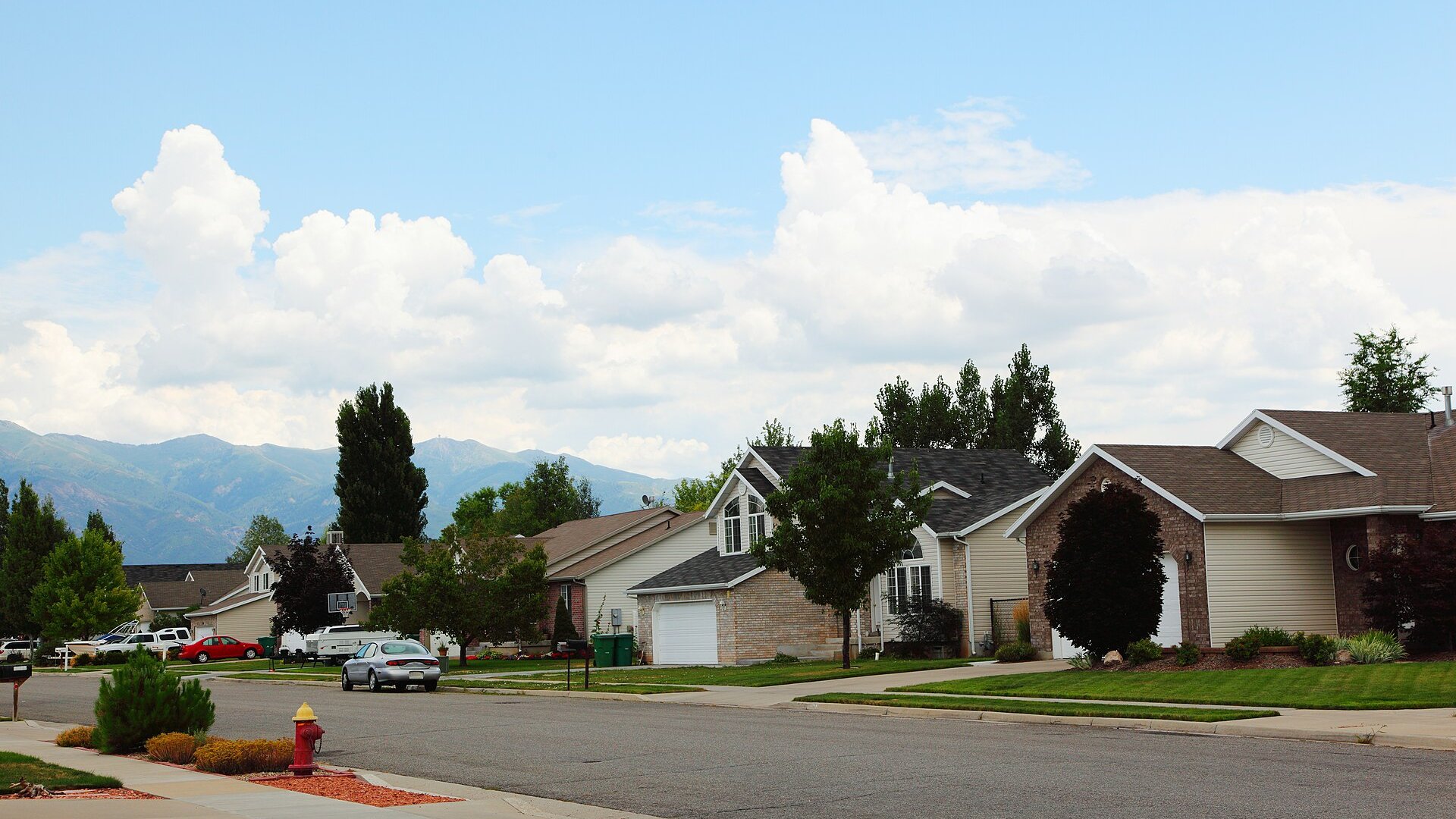
Photo: Single-family homes in a suburban neighborhood. Pink Sherbet Photography via Wikimedia Commons (CC BY 2.0).
Homebuyers will be able to borrow up to $855,400 for a single-family home next year and still qualify for a mortgage backed by Fannie Mae or Freddie Mac, the Federal Housing Finance Agency said Tuesday. The new ceiling takes effect Jan. 1, 2027, and covers most U.S. counties. Buyers in high-cost markets such as Los Angeles and Manhattan, and in Alaska and Hawaii, get considerably more room.
The increase is $22,650 over the 2026 limit of $832,750, a gain of about 2.7%. It is a smaller jump than last year, when the limit rose $26,250, or 3.25%, and well below the increases of more than 5% in each of the two years before that, HousingWire reported. The slowdown mirrors a housing market where prices are still climbing, just not as fast.
Why the limit moves every year
Fannie Mae and Freddie Mac do not make loans themselves. They buy mortgages from banks and other lenders, guarantee them against default and package them into securities sold to investors. That system keeps money flowing to lenders and generally keeps borrowing costs lower for loans that fit the companies’ rules. A key rule is size. A loan at or under the limit is called “conforming.” A bigger one is a jumbo loan, which lenders have to hold or sell elsewhere, often with tighter credit standards.
The Housing and Economic Recovery Act of 2008 requires the FHFA, which regulates both companies, to reset the limit each year to track home values. The agency uses its own house price index. Its third-quarter 2026 reading showed prices up 2.72% from a year earlier, and the baseline limit rises by the same percentage, according to the FHFA announcement.
The formula only works in one direction. When prices fall, the limit does not drop, a point CalculatedRisk highlighted. That is why the limit sat at $417,000 from 2006 through 2016, as prices recovered from the housing crash.
The 2027 numbers
| Category | 2027 limit (one-unit home) |
|---|---|
| Baseline, most of the U.S. | $855,400 |
| High-cost area ceiling | $1,283,100 |
| Alaska, Hawaii, Guam, U.S. Virgin Islands baseline | $1,283,100 |
| Alaska, Hawaii, Guam, U.S. Virgin Islands ceiling | $1,924,650 |
| Four-unit property, baseline area | $1,645,350 |
The high-cost ceiling is set by law at 150% of the baseline. It applies in counties where 115% of the local median home value tops the baseline. The FHFA said the conforming limit will be higher next year in all but 24 U.S. counties or county equivalents.
For example, the one-unit limit in Los Angeles County will hit the $1,283,100 ceiling, and a four-unit property there can carry a loan as large as $2,468,025, according to CalculatedRisk. In New York County, which is Manhattan, the one-unit limit will be $1,224,750, the Associated Press reported. Alaska and Hawaii, along with Guam and the U.S. Virgin Islands, get higher limits through special statutory provisions, the FHFA said.
The housing market behind the number
Slower price growth is the main reason this year’s increase is smaller. The AP noted that sales of previously occupied homes were essentially flat last year at a 30-year low and slipped last month to their weakest annual pace in more than 16 years as mortgage rates rose. HousingWire linked the cooler appreciation to a weaker market and higher-for-longer rates.
Many lenders did not wait for the official number. Rocket Mortgage, CrossCountry Mortgage, Newrez, Guild, Fairway and Movement had already begun accepting conforming loans up to $845,000, according to Scotsman Guide and HousingWire. United Wholesale Mortgage moved to $847,440 and Pennymac to $850,000. Borrowers with those lenders will now see the full $855,400 apply.
Who gains, and by how much
The change matters most for buyers whose loan would have landed just above this year’s $832,750 limit. Under the new ceiling, a loan between roughly $833,000 and $855,400 can be treated as conforming instead of jumbo. That can mean a lower down payment requirement, more lender options and, depending on the market, a better interest rate.
- California and New York: Buyers in expensive metros like Los Angeles and Manhattan get the largest dollar limits in the lower 48, which keeps more mid-range homes in those areas eligible for standard financing.
- Alaska and Hawaii: The baseline of $1,283,100 in both states is 50% above the national figure, giving buyers there far more room before a loan becomes a jumbo.
- Lower-cost states: In most of the Midwest and South, few buyers are near the limit. The more relevant effect there may be on the Federal Housing Administration’s limits, which are tied to the conforming figure.
- Investors in small rentals: Higher limits on two- to four-unit buildings expand financing options for owner-occupants and investors in duplexes and fourplexes.
CalculatedRisk estimated that the low-cost floor for FHA-insured loans should rise to about $556,010, which is 65% of the new conforming baseline. The Department of Housing and Urban Development sets FHA limits separately and typically announces them on its own schedule.
What happens next
The new limits take effect for loans delivered to Fannie Mae and Freddie Mac starting Jan. 1. The FHFA publishes a county-by-county list on its website, which buyers and loan officers can check for their exact limit. HUD’s 2027 FHA limits are the next figure to watch.
For buyers, the bigger factor remains mortgage rates. A higher loan cap helps on the margins, but it does not change monthly payments on a given loan amount. With price growth slowing and sales stuck near multi-decade lows, next year’s adjustment could be smaller still if the trend holds through 2027.
Sources
- Federal Housing Finance Agency: FHFA Announces Conforming Loan Limit for 2027
- AP News: FHFA lifts conforming loan limit to $855,400 as home prices keep climbing
- HousingWire: FHFA raises conforming loan limit to $855,400 in 2027
- Scotsman Guide: FHFA hikes Fannie and Freddie conforming loan limits for 2027
- CalculatedRisk: FHFA Announces Baseline Conforming Loan Limit Will Increase to $855,400 in 2027