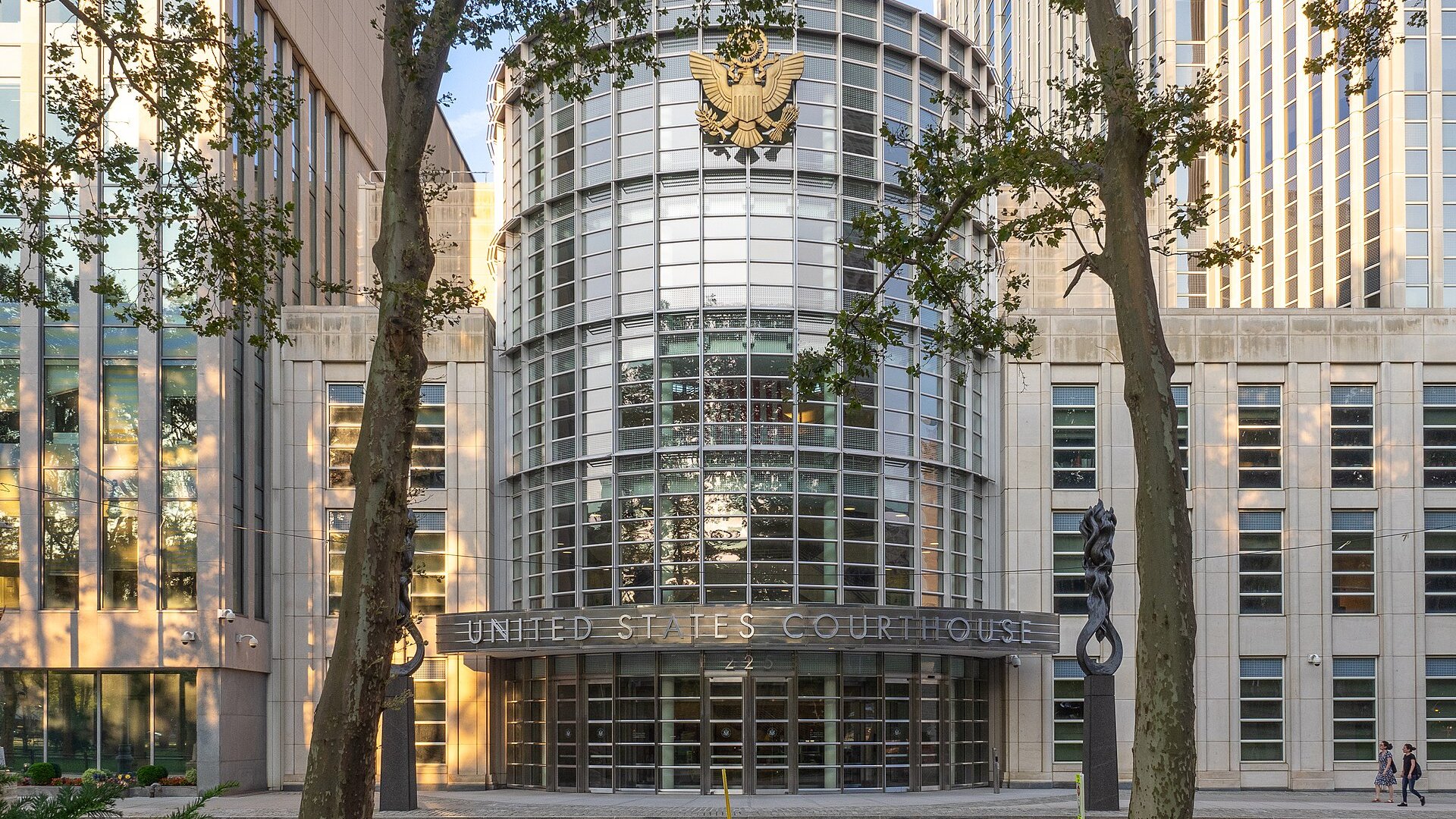
Photo: U.S. Courthouse for the Eastern District of New York in Brooklyn. Ajay Suresh via Wikimedia Commons (CC BY 2.0).
A federal jury in Brooklyn, New York, convicted Chinese telecommunications giant Huawei Technologies on Tuesday of conspiring to steal trade secrets from American companies, defrauding banks and evading U.S. sanctions on Iran. The same jury acquitted the company of the two charges that framed the government’s broadest theory of the case: racketeering conspiracy and conspiracy to obstruct justice.
The split verdict, 10 guilty counts out of 12, closes the trial phase of one of the longest-running corporate prosecutions the Justice Department has brought against a foreign technology firm. No individual defendant stood trial. Huawei and three U.S.-linked subsidiaries, Huawei Device, Futurewei Technologies and Huawei Device USA, were the defendants, according to The Next Web and Wccftech.
U.S. District Judge Ann Donnelly set sentencing for Sept. 14, 2027, Wccftech reported. The Associated Press said the company could face penalties in the billions of dollars. Possible punishments include criminal fines, forfeiture and restitution.
What the jury decided
Jurors deliberated for roughly seven days before returning the verdict, according to Wccftech. The guilty counts fall into three broad groups.
- Trade secrets: conspiracy to steal proprietary technology from U.S. companies.
- Financial crimes: wire fraud, bank fraud and money laundering conspiracy tied to how Huawei described its business in Iran to lenders.
- Sanctions: conspiracy to evade U.S. sanctions on Iran. The AP reported the convictions also covered doing business in countries under sanctions, including North Korea, and making false statements to U.S. officials and banks.
The acquittals matter as much as the convictions. The racketeering charge, borrowed from the playbook usually aimed at organized crime, was the government’s vehicle for arguing that Huawei operated as a corrupt enterprise from the top down. Defense attorney Brian Heberlig told reporters outside the courthouse that the not guilty findings were a vindication of the company’s compliance culture. Wccftech reported Heberlig also said the forfeiture exposure tied to the racketeering count is now off the table.
How the case got here
The prosecution traces back to an indictment first unsealed in January 2019. A superseding indictment returned in Brooklyn on Feb. 12, 2020, expanded the case to 16 counts and added the racketeering and trade secret conspiracy charges, according to a Justice Department release from that time. That indictment also named Skycom Tech Co., which prosecutors described as Huawei’s unofficial Iran subsidiary, and the company’s chief financial officer, Wanzhou Meng.
The 2020 indictment accused Huawei of taking source code, antenna designs and robot testing technology from six U.S. technology companies. Prosecutors said the company did it by signing confidentiality agreements and then misusing what it learned, by recruiting employees away from rivals, and by using university researchers as go-betweens. The indictment also described an internal bonus program that allegedly rewarded staff for gathering competitors’ confidential information. Prosecutors said Huawei used code names for sanctioned countries, “A2” for Iran and “A9” for North Korea.
Trial coverage by The Next Web named five companies whose technology was at issue: Cisco, T-Mobile, Fujitsu, CNEX and Quintel. In the Cisco episode, prosecutors said Huawei engineers copied router source code. In the T-Mobile episode, prosecutors said Huawei collected details about a phone testing robot the carrier used, and that one employee walked out of a restricted lab with a piece of it.
The bank fraud counts centered on Skycom. Prosecutors argued Huawei told HSBC and other lenders that Skycom was an independent company, which helped Huawei keep access to billions of dollars in financing and to U.S. dollar clearing. Huawei’s lawyers countered that the banks already knew about its Iranian ties, according to Wccftech.
What each side said
The Justice Department described the verdict as a major win. Brooklyn U.S. Attorney Joseph Nocella Jr. said in a statement, quoted by the AP, that few crimes are as serious as Huawei’s pattern of endangering national security and impeding U.S. law enforcement. Attorney General Todd Blanche said no person or company is above the law. Tysen Duva, an assistant attorney general in the Criminal Division, said Huawei “built its global empire on a foundation of fraud, theft, and deception,” The Next Web reported.
Huawei welcomed the racketeering acquittal and said the remaining charges lack legal or factual merit. The company said the five trade secret disputes raised at trial were civil matters that had been resolved over the past two decades, and that it would review the verdicts and take all necessary legal steps. Heberlig said Huawei would appeal. He argued prosecutors had stitched isolated misconduct by a handful of the company’s more than 200,000 employees into a conspiracy that did not exist.
What it means for New York, Washington and California
The verdict is a significant result for the Eastern District of New York, which carried the case through years of pretrial fights and a trial that ran for roughly two to three months, depending on the account. It also adds weight to the office’s role as a leading venue for national security prosecutions involving foreign companies.
For the American firms named at trial, the conviction offers a criminal finding on conduct they had previously pursued mostly through civil channels. That includes T-Mobile, based in Bellevue, Washington, and Cisco, based in San Jose, California. A criminal judgment does not by itself award those companies money, but restitution is among the penalties the court can impose at sentencing.
The broader policy impact is less direct. Huawei has been on the Commerce Department’s trade blacklist since 2019, which already restricts its access to American technology, so the verdict does not change day-to-day market access for U.S. carriers or consumers. The Next Web noted that some U.S. companies still strike deals with Huawei, including a patent arrangement with Qualcomm covering 5G, artificial intelligence and networking.
What happens next
- Post-trial motions: Huawei is expected to challenge the verdict before sentencing and then appeal to the U.S. Court of Appeals for the Second Circuit.
- Sentencing on Sept. 14, 2027: Judge Donnelly will decide fines, forfeiture and any restitution. Heberlig said it was too early to predict the outcome.
- Diplomatic reaction: No formal response from Beijing had been reported in the coverage reviewed for this story as of Wednesday morning.
With the racketeering count gone, the size of any penalty will hinge on the fraud, sanctions and trade secret convictions. That gives both sides months to argue over what the verdict is worth.
Sources
- AP News: Huawei is convicted in US of stealing trade secrets
- The Next Web: US jury convicts Huawei of trade secret theft and bank fraud
- Wccftech: Huawei found guilty on 10 of 12 counts, cleared of racketeering
- The Bureau: Huawei convicted on 10 counts, acquitted of racketeering
- U.S. Department of Justice: Huawei and subsidiaries charged in racketeering conspiracy (2020)