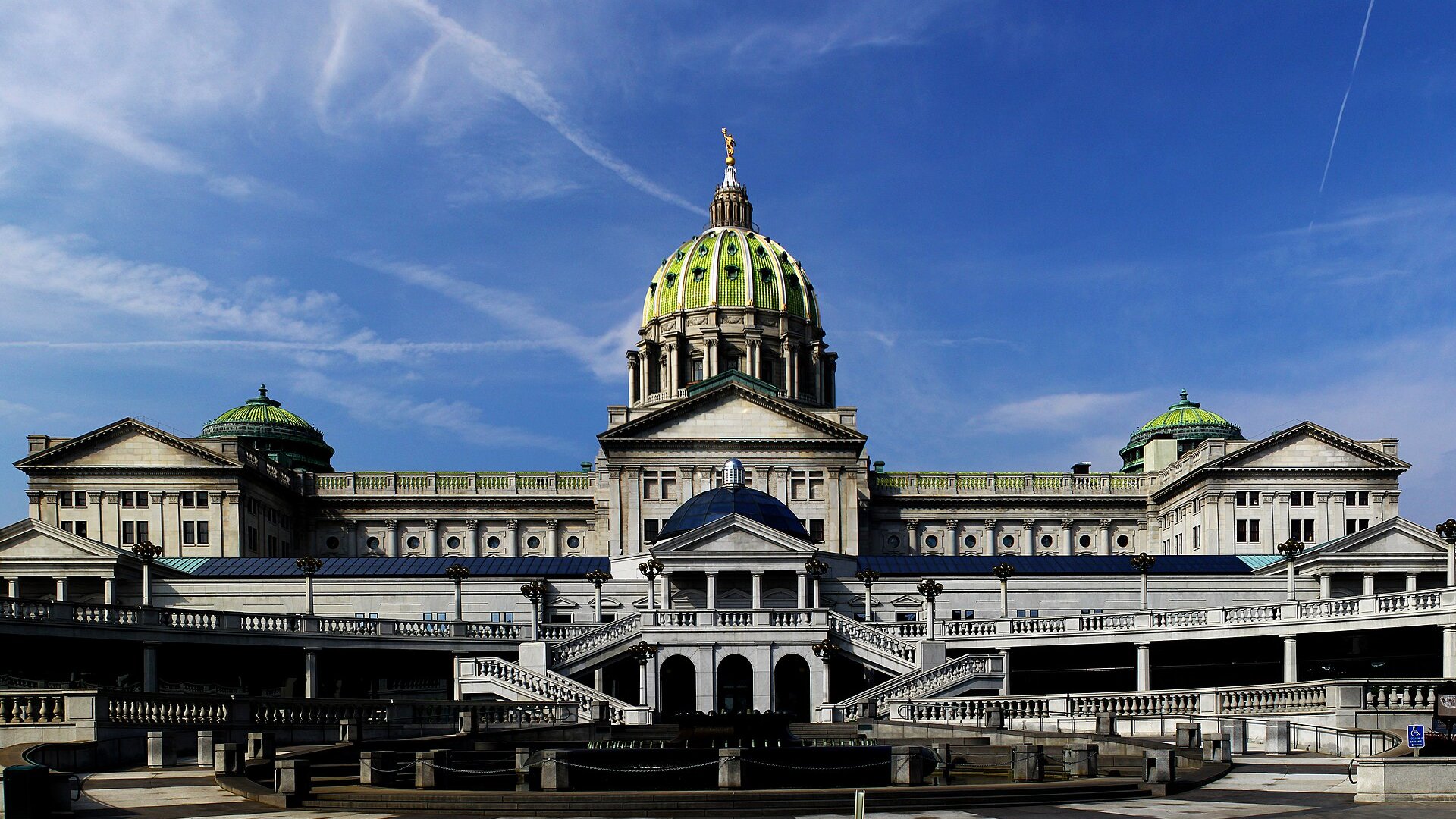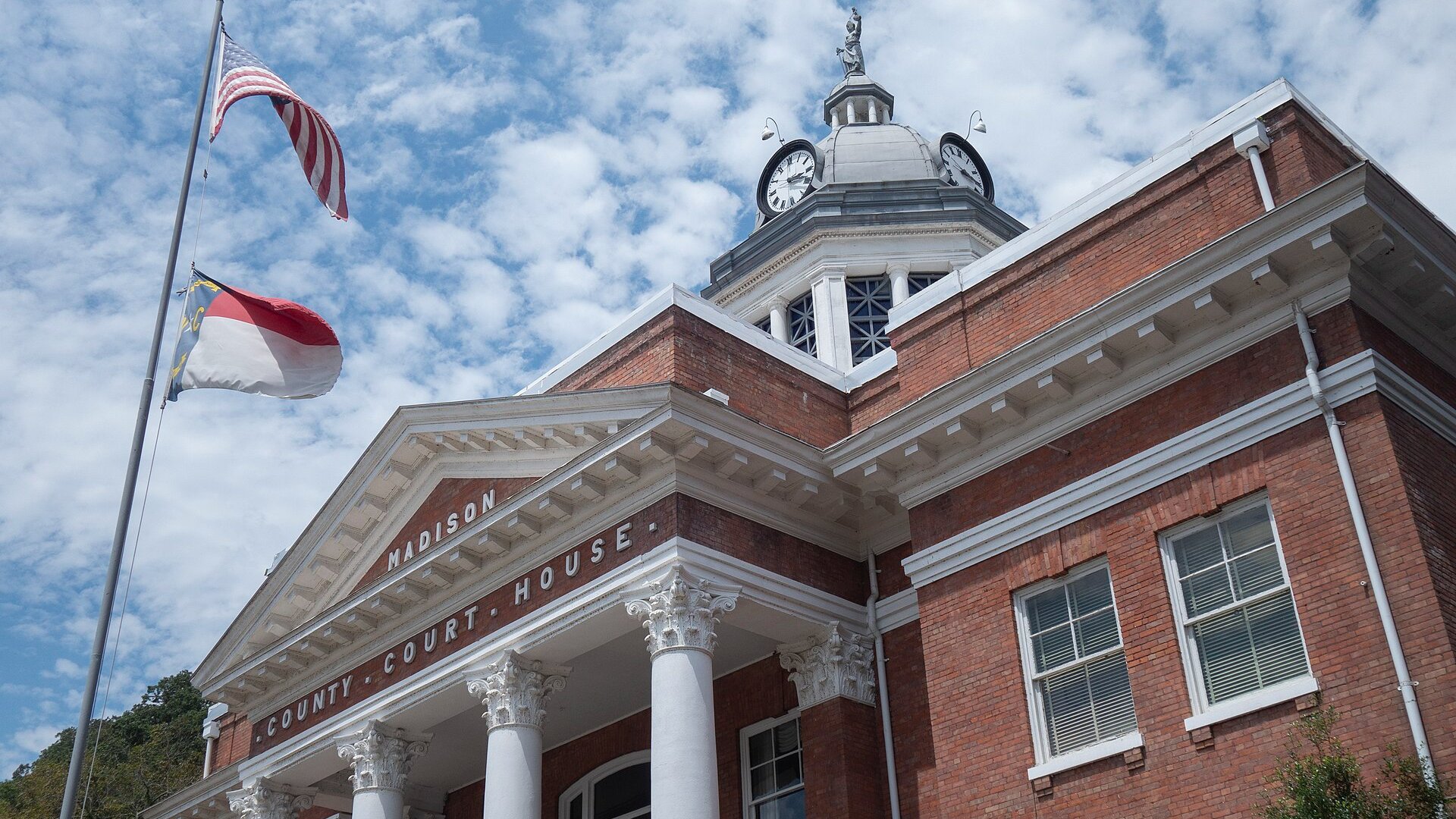
Photo: The historic Madison County Courthouse in Marshall, North Carolina, one of the buildings slated for Helene recovery funding. Nicholas Hartmann via Wikimedia Commons (CC BY-SA 4.0).
North Carolina Gov. Josh Stein announced $37.8 million in federal disaster recovery grants on Monday, Nov. 23, to rebuild commercial districts in western North Carolina that Hurricane Helene damaged. The governor’s office also announced more than $24 million for nine regional airports that became supply lifelines after the storm cut off mountain communities.
Stein made the downtown announcement in Swannanoa, one of the Buncombe County communities hit hardest by the 2024 storm. He was joined by two members of the state’s congressional delegation from opposite parties: Republican U.S. Sen. Ted Budd and Democratic Sen.-elect Roy Cooper, according to the governor’s office and NC Newsline.
Where the downtown money is going
The funds come from the federal Community Development Block Grant Disaster Recovery program, known as CDBG-DR, and are distributed through Renew NC’s Commercial District Revitalization Program inside the N.C. Department of Commerce. The state described them as conditional awards.
Demand far outstripped the money. Local governments and nonprofits requested $153 million in the first round, which had $40 million available. The state awarded $37,797,975 to six projects, ranked by applicant capacity, community need, development approach, outside funding and expected long-term results, according to the governor’s release.
NC Newsline reported these awards:
- Buncombe County, $10 million: The Swannanoa Commercial Corridor Revitalization project, including about two miles of new sidewalk along U.S. 70 between Warren Wilson Road and Whitson Avenue and cleanup of storm-damaged commercial property.
- Town of Marshall, $10 million: Renovation of the 118-year-old Madison County courthouse, whose first floor flooded during Helene. Court proceedings moved out of the building after the storm.
- Morganton, $6.8 million: Renovation of the COMMA Performing Arts Center.
- Lake Junaluska Assembly, $4.6 million: Commercial revitalization at Stuart Auditorium.
- Hot Springs, $2.1 million: New business space on Main Street.
The state’s list of first-round recipients also includes the Big Horse Creek Floodplain Restoration, Resilient Public Access, and Hazard Mitigation Project.
“These investments will help revitalize commercial districts that are essential to western North Carolina’s long-term recovery,” Stein said in the release.
Airports that kept the region supplied
In a separate announcement, Stein and North Carolina Emergency Management said nine western airports will share more than $24 million from the Aerial Asset Accessibility Grant Program. Seventeen airports applied, asking for about $72 million in total.
After Helene, landslides, washouts and fallen trees closed hundreds of roads. Small general aviation airports turned into staging areas for supplies and first responders, and air traffic over western North Carolina jumped 300% after the storm, according to state transportation and Federal Aviation Administration data cited by the governor’s office.
The grants will pay for standby generators, new hangars, a new terminal and more fuel storage. Recipients are the Ashe County, Avery County, Jackson County, Rutherford County, Western Carolina Regional, Wilkes County, Lincoln County Regional, Shelby-Cleveland County Regional and Foothills Regional airports. Jackson County’s award covers a new terminal building, and Shelby-Cleveland County’s funds a fuel farm.
Under rules set by the General Assembly, an eligible airport must have fuel available around the clock, keep aviation mechanics on site, be able to stay open 24 hours a day during a state of emergency and sit in a county that agrees to give the state access to the funded facilities. Airports with commercial passenger service were not eligible.
“We never know when the next storm will strike,” Stein said in the airport announcement.
Background and timeline
Helene’s floodwaters damaged downtowns, roads and public buildings across the North Carolina mountains, and recovery money has arrived in waves from state and federal sources. Monday’s awards tie into the Western North Carolina Economic Recovery Plan, a long-range framework the governor released in September. That plan calls for infrastructure built to last and for a regional air-access strategy that spreads economic activity beyond Asheville.
- Late September 2024: Hurricane Helene floods much of western North Carolina, isolating many mountain communities.
- April 2026: Renew NC launches the Commercial District Revitalization Program.
- September 2026: Stein releases the Western North Carolina Economic Recovery Plan.
- Nov. 23, 2026: First-round downtown awards and airport grants are announced.
- December 2026: Second-round downtown funding opportunity expected.
Reactions
Commerce Secretary Lee Lilley said in the state’s release that the awards would help local leaders turn recovery plans into real projects. The appearance of Budd and Cooper alongside the Democratic governor reflected the bipartisan support Helene recovery has drawn in Raleigh and Washington, though neither senator’s remarks were included in the published accounts.
The scale of unmet need is also clear in the numbers. The first round attracted nearly four times as many dollars in requests as were available, and only about half of the airports that applied received grants.
What it means for North Carolina
For towns like Marshall and Hot Springs, where a handful of blocks carry most of the local economy, the money targets the buildings and streets that bring in visitors and customers. In Marshall, the funds give Madison County a path to restoring a landmark courthouse that has sat largely unused since the flood. In Swannanoa, the sidewalk work along U.S. 70 is meant to make the corridor safer for pedestrians and easier to reach for shoppers.
The airport grants are aimed at the next disaster as much as the last one. Backup power, hangar space and fuel capacity were among the gaps state officials identified during the Helene response, and the upgrades are designed to let these airports keep operating when mountain roads cannot.
What happens next
The Department of Commerce’s Division of Community Revitalization expects to open a second round in December with the remaining $73.7 million in CDBG-DR money. Local governments and nonprofits in the federally and state-designated most impacted counties, including Buncombe, Haywood, Madison, McDowell, Watauga and Yancey, will be eligible. The state is encouraging applicants to use an optional prescreening process to check whether projects meet federal requirements before applying. Information is posted at commercerecovery.nc.gov.
Sources
- Office of the Governor: Governor Stein Announces $37.8 Million to Support Commercial District Revitalization in Western North Carolina
- Office of the Governor: Governor Stein Announces Aerial Asset Accessibility Grant Program Is Taking Off
- NC Newsline (via News From The States): Millions flow to WNC to aid in Helene recovery