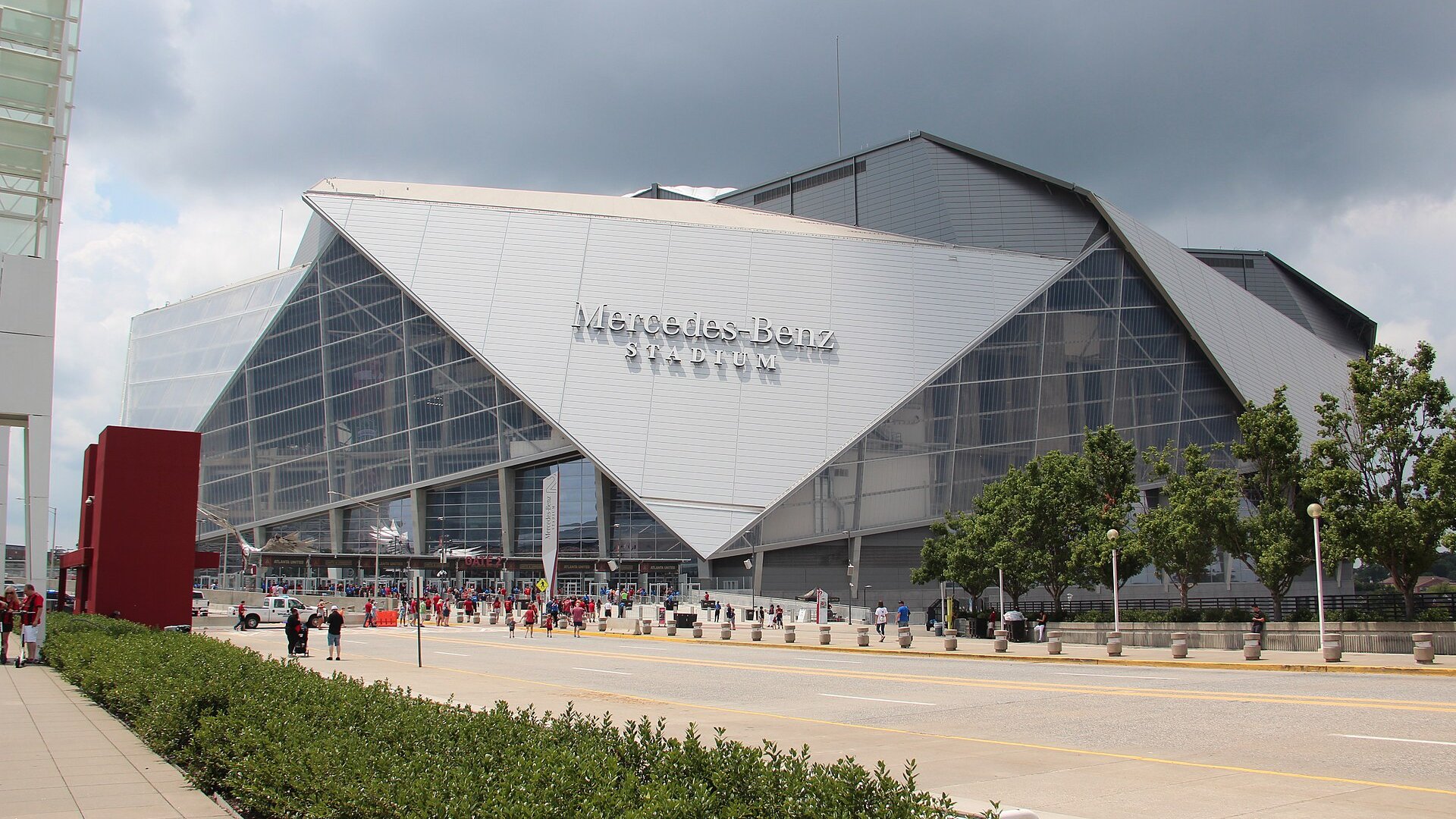
Photo: Mercedes-Benz Stadium in Atlanta, one of 14 U.S. venues proposed for the 2031 tournament. Thomson200 via Wikimedia Commons (CC0).
The United States will host the FIFA Women’s World Cup for a third time after FIFA’s member associations on Monday, Nov. 23, awarded the 2031 tournament to a joint bid from the U.S., Mexico, Costa Rica and Jamaica. The bid put forward 14 American stadiums, spread across 11 states and the District of Columbia, as possible venues.
The decision was made at an Extraordinary FIFA Congress in Zurich, Switzerland, according to U.S. Soccer. The same session confirmed England, Northern Ireland, Scotland and Wales as hosts of the 2035 Women’s World Cup. Neither award came as a surprise. Each tournament drew a single bid, and neither FIFA nor U.S. Soccer reported a vote count in its announcement.
The 2031 edition will be the largest women’s World Cup ever staged. U.S. Soccer said it will be the first with 48 teams, the first with 104 matches and the first senior Women’s World Cup shared by four host countries. The most recent tournament, held in Australia and New Zealand in 2023, had 32 teams.
For FIFA’s evaluation, the bid listed 20 potential stadiums: 14 in the United States, four in Mexico and one each in Costa Rica and Jamaica, FIFA said. The Stadium Business reported that organizers also named a much wider pool of more than 30 candidate cities and more than 45 stadiums that could be considered later.
The U.S. venues named in the evaluation were Mercedes-Benz Stadium in Atlanta, Bank of America Stadium in Charlotte, AT&T Stadium in the Dallas area, Empower Field at Mile High in Denver, NRG Stadium in Houston, Arrowhead Stadium in Kansas City, SoFi Stadium in the Los Angeles area, U.S. Bank Stadium in Minneapolis, Geodis Park in Nashville, MetLife Stadium in the New York and New Jersey market, Camping World Stadium in Orlando, Snapdragon Stadium in San Diego, Lumen Field in Seattle and the planned new stadium at the RFK site in Washington, D.C. Seven of them staged games at this summer’s men’s World Cup.
None of those sites is guaranteed a match yet. U.S. Soccer said host cities, stadiums, the match schedule and ticketing will be announced as planning moves forward with FIFA and the other three federations. No stadium has been proposed for the final, and tournament dates have not been released.
What leaders said
U.S. Soccer President Cindy Parlow Cone, who also sits on the FIFA Council, welcomed the award. “This is a historic moment for our four countries,” she said in the federation’s announcement, adding that the partners want to use the event to speed up the growth of the women’s game around the world.
FIFA President Gianni Infantino tied the decision to the governing body’s broader push to expand the sport. “Our objective, of course, is making women’s football truly global,” he said, according to FIFA.
Leaders of the three partner federations also weighed in, FIFA reported. Mexican federation president Mikel Arriola highlighted the jump to a 48-nation field. Osael Maroto, head of Costa Rica’s federation, said visitors would get to enjoy the country’s pura vida lifestyle, and Jamaican federation president Michael Ricketts said hosting games would be good for his country.
Across the Atlantic, the chief executives of the four British football associations called the 2035 award a “landmark moment” in a joint statement reported by The Stadium Business. No rival bid or organized opposition to either award was reported.
Background: how the U.S. got here
The United States has a long history with the event. The U.S. women’s national team has won four World Cup titles, more than any other country, USA Today noted, though its 2023 campaign ended in the round of 16 against Sweden, its earliest exit ever.
- 1999: The U.S. hosts and wins the Women’s World Cup, beating China on penalties in the final at the Rose Bowl in Pasadena, California.
- 2003: The U.S. steps in with roughly four months of notice after China loses hosting rights during the SARS outbreak. Germany wins the final at the Home Depot Center in Carson, California.
- April 2025: The United Kingdom is confirmed as the only bidder for 2035, and Infantino says interest in 2031 has come from the U.S. and possibly other Concacaf nations.
- October 2025: U.S. Soccer names Mexico, Costa Rica and Jamaica as co-hosts on its 2031 bid.
- Summer 2026: The U.S., Mexico and Canada co-host the men’s World Cup.
- Early November 2026: FIFA publishes its evaluation reports on the 2031 and 2035 bids.
- Nov. 23, 2026: The FIFA Congress formally awards both tournaments.
What it means for Georgia, Texas, California, Florida and Washington
The award sets up a fresh round of competition among American cities. Texas and California each have two stadiums on the evaluation list: AT&T Stadium and NRG Stadium in Texas, and SoFi Stadium and Snapdragon Stadium in California. Georgia’s Mercedes-Benz Stadium, Washington’s Lumen Field and Florida’s Camping World Stadium in Orlando are also in the running, along with venues in North Carolina, Colorado, Missouri, Minnesota, Tennessee, New Jersey and the District of Columbia.
Cities that just hosted men’s World Cup matches, including Atlanta, Houston, the Dallas area, Kansas City, Los Angeles, Seattle and the New York and New Jersey region, can point to venues and operations tested this year. Charlotte, Denver, Minneapolis, Nashville, Orlando, San Diego and Washington, D.C., did not host games at the 2026 men’s tournament, so 2031 could give them their first matches of this World Cup cycle.
Several 2026 men’s hosts, among them Boston, Philadelphia, Miami and the San Francisco Bay Area, were not on the 14-stadium evaluation list. The bid’s larger pool of candidate cities leaves room for the map to change before final selections are made, and it is not yet known how many U.S. stadiums will ultimately be used.
What happens next
Brazil will host the next Women’s World Cup in 2027. Meanwhile, U.S. Soccer said the four 2031 host federations will work with FIFA on choosing host cities and stadiums, building the match schedule and setting up ticketing, with details to be shared as planning progresses. No timeline for those decisions has been announced.
The federations also said they plan to work with FIFA and Concacaf on girls’ player development, coaching education and infrastructure investment across the region in the years leading up to the tournament.
Sources
- U.S. Soccer: United States, Mexico, Costa Rica and Jamaica Awarded FIFA Women’s World Cup 2031
- FIFA: Four Concacaf co-hosts celebrate pending FIFA Women’s World Cup 2031 impact
- The Stadium Business: FIFA confirms hosts for 2031, 2035 Women’s World Cups
- USA Today (via Yahoo Sports): United States awarded 2031 Women’s World Cup: Here’s when U.S. hosted before