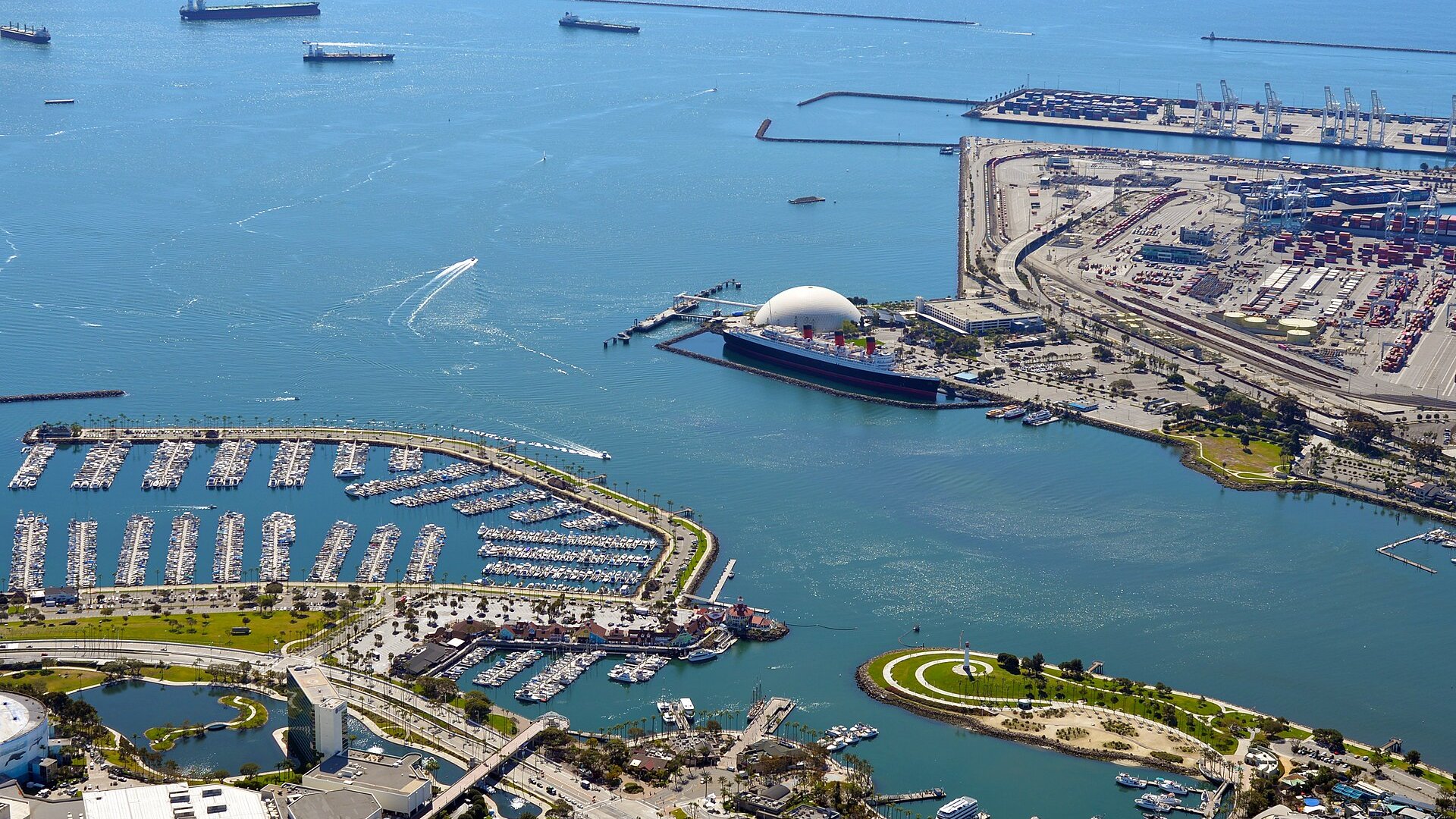
Photo: Container terminals at the Port of Long Beach, California. Don Ramey Logan via Wikimedia Commons (CC BY-SA 4.0).
The Trump administration on Wednesday proposed a new layer of tariffs of 15% to 35% on goods from China, the European Union, Japan, South Korea, Taiwan and nine other economies, saying their governments prop up factories that produce far more than their home markets can absorb. The duties would not start until after public hearings that begin Jan. 25, 2027, but they could eventually reach roughly three-fifths of everything the United States imports, the Associated Press reported.
The Office of the U.S. Trade Representative released findings in 14 of the 16 investigations it opened in March into what it calls “structural excess capacity” in manufacturing. Probes of Mexico and Norway remain open. The agency also proposed separate penalties on Brazil, including a new 10% tariff on finished commercial aircraft and higher duties on sugar imported above quota levels.
For American shoppers and businesses, the practical message is mixed. The rates are broad, but economists quoted by AP and Reuters said most of them would roughly restore the tariff levels that were in place before the Supreme Court struck down the president’s emergency tariffs in February. Goldman Sachs estimated the plan would lift the overall U.S. tariff rate from 7.8% to 9.2%, with what it called a very small added effect on inflation.
Who would pay what
The proposed rates differ by trading partner, and most come with a second, higher figure the trade office could apply if negotiations or existing trade deals fall short. According to a summary of the Federal Register notices by the law firm Baker McKenzie, the main proposed rates are:
- China: up to 20%, with a lower rate of up to 10% on goods in one annex and an exemption for a list of products tied to the current U.S.-China truce. The fallback rate is up to 40%.
- European Union, Japan, South Korea, Switzerland and Taiwan: 15%, counting ordinary duties already charged. Fallback rates range from 20% to 25%.
- Indonesia, Malaysia, Thailand, Cambodia and Bangladesh: up to 18%, with fallbacks of 20% to 25%.
- Vietnam: up to 35%, dropping to 20% if it signs a trade agreement with Washington.
- India: up to 25%, or 17% with a deal.
- Singapore: up to 20%, or 10% with a deal.
For every economy except China, the new tariffs would not apply to products already covered by national security tariffs under Section 232, including steel, aluminum, copper, cars and trucks, lumber, patented drugs and semiconductors. Each notice also carries a list of exempt goods, such as raw materials the U.S. cannot easily produce. Reuters reported that roughly $30 billion in Chinese goods under review for tariff cuts would be spared.
Stacking is the detail importers will watch closest. For some Chinese products, AP reported, the new 20% charge would sit on top of older levies for a combined rate of 45%. For most other countries, the proposals are written net of existing Section 301 duties, which means they are meant to replace, not add to, the 10% to 12.5% forced labor tariffs announced in July for 60 trading partners.
Why the administration is doing this now
The proposal is the latest step in a yearlong effort to rebuild the president’s tariff program on firmer legal footing. In February, the Supreme Court ruled that the International Emergency Economic Powers Act did not let the president impose sweeping import taxes on his own. The administration responded with temporary tariffs and then two sets of investigations under Section 301 of the Trade Act of 1974, a law that lets the trade office act against foreign practices it finds unreasonable or discriminatory.
Section 301 requires a detailed, country-by-country record, and the trade office produced one. Its report on China alone runs 456 pages, AP reported. Baker McKenzie noted that the agency heard from nearly 140 witnesses and received 1,070 written comments during the investigation. The findings point to industrial plans, state-backed lending, weak labor protections and market barriers that, in the agency’s view, cost American factories sales, jobs and investment.
Trade Representative Jamieson Greer told CNBC that partners had been briefed in advance. “I think a lot of this is baked in,” he said, according to AP.
Reaction from Congress, business and abroad
Democrats, who won control of both the House and the Senate in this month’s midterm elections, signaled opposition. Sen. Ron Wyden of Oregon, expected to lead the Senate Finance Committee in January, called the move an attempt to rebuild tariffs the courts had already rejected and pledged to fight it. Repealing the duties would still be difficult, though. Some Democrats favor tougher action on China, and the president could veto any bill to undo the tariffs.
The small business coalition We Pay the Tariffs said its members cannot absorb another round of costs. On the other side, Derek Scissors of the American Enterprise Institute argued the China rate was too modest to change Beijing’s behavior, AP reported.
China’s foreign ministry repeated its opposition and urged talks, while a spokesperson for China’s embassy in Washington told Reuters that the overcapacity issue “does not really exist.” Brazil’s government called the proposed aircraft and sugar duties unacceptable and said it would not rule out retaliation. Stock markets were already under pressure Wednesday, with major indexes opening more than 1% lower amid a broader selloff in technology shares, Reuters reported.
What it means for the states
Because the proposal touches most imports, its effects would spread well beyond any single state. Retailers and manufacturers in every state that buy parts or finished goods from Asia and Europe would face new costs once the duties take effect, unless their products fall under an exemption. Port regions that handle large volumes of Asian and European cargo, including Southern California, the Pacific Northwest, the Gulf Coast and the East Coast hubs in Georgia, New Jersey and New York, would feel any shift in shipping patterns first.
Farm states have a separate stake. The U.S.-China truce that shapes China’s treatment under the plan expires Jan. 10, 2027, and its future is tied to China’s purchases of American agricultural products. President Trump is scheduled to host Chinese leader Xi Jinping at the Group of 20 summit in Florida next month, where the truce, farm purchases and rare earth minerals could come up again, according to AP.
Companies that rely on Brazilian sugar or on regional jets from Embraer, Brazil’s largest aircraft maker, would also be exposed to the separate Brazil measures.
What happens next
- Jan. 5, 2027: deadline for written comments and requests to testify, according to Baker McKenzie.
- Jan. 10, 2027: scheduled expiration of the U.S.-China trade truce.
- Jan. 25, 2027: public hearings begin. AP reported the tariffs are unlikely to take effect before February or March.
- Pending: decisions on Mexico and Norway, which remain under investigation.
Legal challenges are likely. Trade lawyer Ryan Majerus told AP that some of the July forced labor tariffs could be vulnerable in court, and the new duties may draw similar suits. Businesses that import from any of the 14 economies have about six weeks to file comments before the hearing window opens.
Sources
- AP: US to hike tariffs on China, EU, Brazil and others over subsidized factories
- Reuters via The Korea Times: US proposes tariffs over excess production, retains 15% cap for Korea, Japan, EU
- Baker McKenzie: USTR Proposes Section 301 Tariffs on 14 Economies Over Structural Excess Capacity